If you’re wondering how much weight can a deck hold, here’s the direct answer: a properly built residential deck is engineered to support 50 pounds per square foot — 40 psf for occupants and furnishings, plus 10 psf for the permanent structure. That figure comes from the International Residential Code and is the baseline every permitted build must meet. Know it, and the rationale behind every design decision your builder makes starts to make sense.
Most homeowners never think about deck load capacity until something feels wrong — a bounce underfoot, a crack near a post, a visible sag. By then you’re dealing with a problem that should have been caught earlier. We build decks in San Antonio every day, and this guide covers what you need to know about deck weight limit before you build, before you load up an existing structure with heavy furniture, or before you add something like a hot tub or outdoor kitchen.
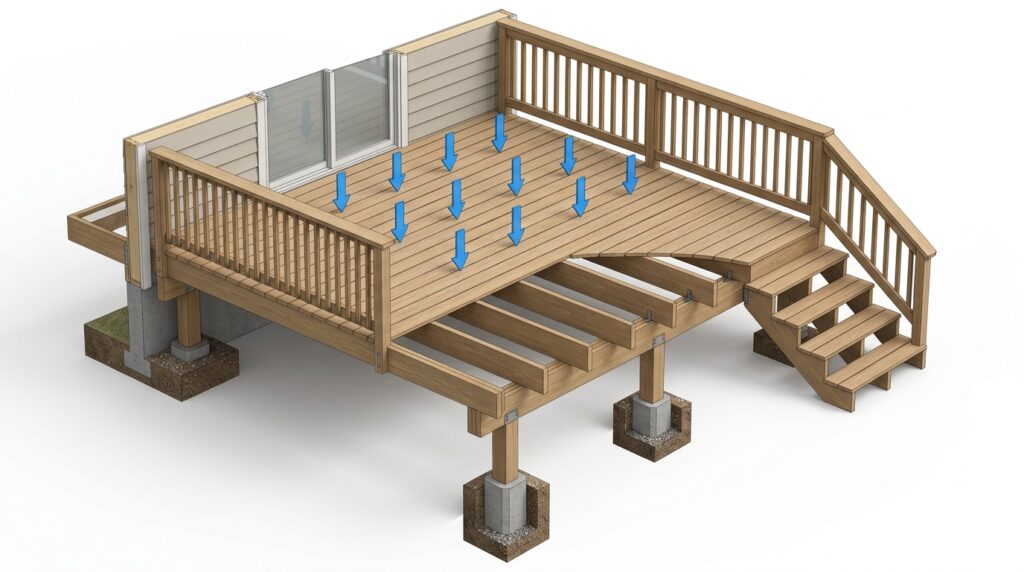
The minimum for residential decks across most jurisdictions is 40 psf for people and furnishings, plus 10 psf for the structure’s own mass. Those two figures sum to 50 psf and define the design target your builder works from.
That 50 psf is a floor, not a ceiling. A well-built deck can handle significantly more if the joists, footings, and connections are sized for it. What your deck can actually bear depends on how it was constructed, not just what permits require. That’s the part most homeowners don’t realize until they’re planning something specific.
In deck engineering, live load means everything that moves on and off the structure: people, chairs, grills, planters. Residential standards set this at 40 psf because that’s a conservative estimate for a fully occupied outdoor space during peak use — a packed party with everyone pressed against the railing.
Dead load is the permanent mass baked into the build: boards, joists, beams, railings, built-in features. Standard practice uses 10 psf as the baseline, though dense materials like thick composite decking or tropical hardwoods push that number up. Whenever you swap surface materials on an existing structure, that figure deserves a second look.
Here’s why the distinction matters for deck safety: the occupant side of the equation changes every time you use the space. Engineers plan for peak use, not average use. That’s why the 40 psf figure applies even when most evenings on your deck are quiet.
In northern climates, winter accumulation stacks on top of those two numbers, sometimes pushing total requirements past 70 psf. San Antonio gets essentially no measurable snowfall, so that factor drops out entirely. What we engineer around in Bexar County is heat, UV, and highly expansive clay soils — covered below.
The math is simple: square footage multiplied by the psf rating. For a 12×12 deck at the standard 40 psf occupant figure: 144 sq ft × 40 psf = 5,760 pounds of evenly distributed occupant capacity. Add the structural portion (144 × 10 psf = 1,440 lbs) and the total design figure is 7,200 pounds — provided joists and footings were sized to carry it.
The word to focus on is distributed. That 5,760-pound figure doesn’t mean you can pile everything onto a single spot. Concentrated point loads, like a filled hot tub sitting on 20 square feet, can exceed local limits even when the total is within range. That’s the distinction that catches homeowners off guard.
For a 16×20 deck (320 sq ft), the occupant-side figure at 40 psf is 12,800 pounds. Useful to know — but only if the build met that standard from the start. An older or unpermitted structure may fall short of even the minimum.
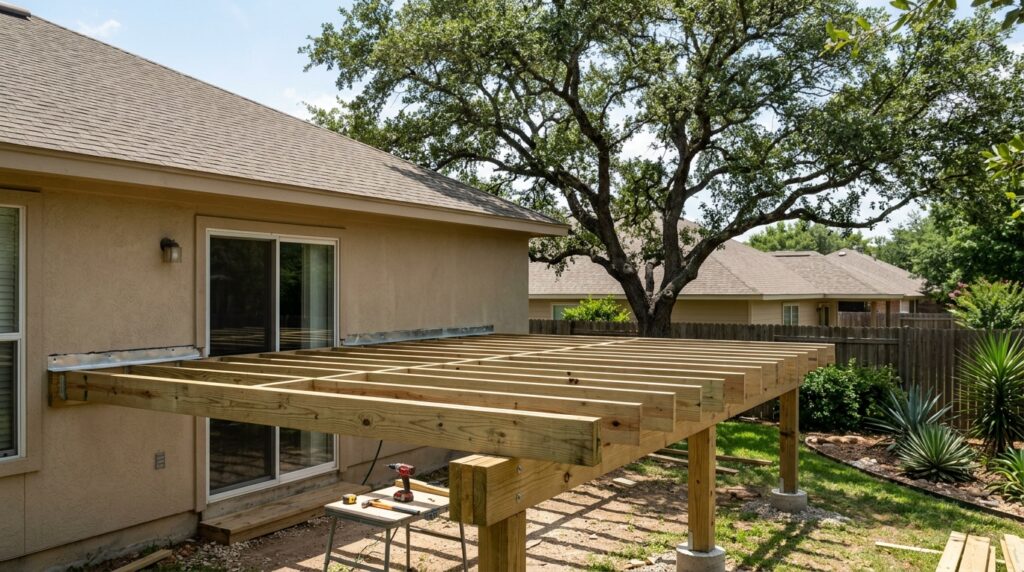
Two decks with identical square footage can have very different actual performance depending on how they were built. The decisions made below the surface drive performance far more than the boards you see from above: joist size and spacing, beam dimensions, column placement, footing depth.
Joists transfer forces from the surface down to the beams. A 2×10 joist at 12-inch spacing carries significantly more than the same size at 16-inch on center. Closer spacing puts more members under the same area, increasing stiffness and reducing deflection. When we design a deck for heavy use, tightening joist spacing is one of the most effective upgrades available.
Beams move forces from the joists out to the support columns. Undersized beams — common in older builds — are usually the first members to show stress. Sagging here is a structural problem, not a cosmetic one. Reducing the span between columns cuts stress on the beam and is often the most practical path to additional support without replacing the beam entirely.
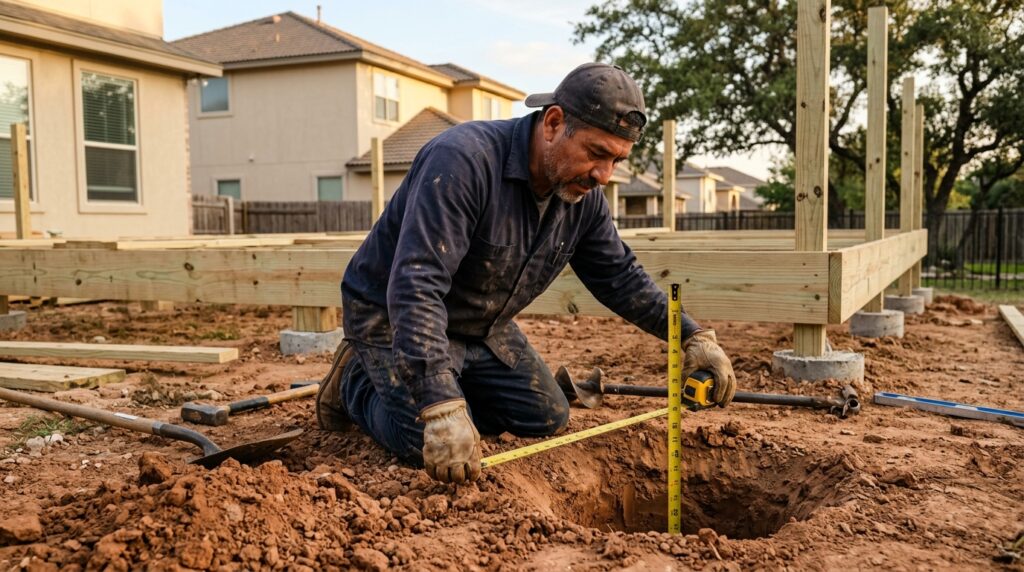
Footings transfer everything to the ground. Their sizing depends on what they carry and the bearing capacity of the soil below. In San Antonio, expansive clay means footings need extra attention. Undersized or shallow footings on clay are among the most common causes of long-term movement here. We cover this in the San Antonio section below.
Composite decking and hardwoods are denser than standard pressure-treated lumber, adding to the structure’s total at the 10 psf tier. On most projects the difference is modest. On a large build with tight margins — or when swapping materials on an existing structure — it’s worth recalculating.
A filled hot tub typically runs 3,000 to 5,000 pounds depending on size and water volume. Most standard builds designed to the 40 psf minimum are not adequate without reinforcement. A 400-gallon tub on 25 square feet delivers roughly 120–160 psf to that footprint — three to four times what a standard residential build is rated for.
Plan for it from the start. We build pool and spa deck structures with dedicated column placement, heavier joists, and the footing sizing a hot tub requires. Adding one to an existing build that wasn’t designed for it is a different project: possible, but it needs a full assessment and likely significant reinforcement work.
Reinforcing for a hot tub means placing columns directly under the tub location, doubling or tripling joists in that zone, and potentially upgrading footings below. That work happens from underneath, which is why the original build is the best time to do it. If you’re considering a hot tub on an existing structure, call us before you place the order — not after it shows up on a truck.
A structure under stress will usually warn you before it fails. The problem is homeowners often dismiss these signs as cosmetic. Know what to watch for.
If any of these are present, don’t add more to the structure. Get a professional to assess it before heavy use. Our deck repair service is built for exactly this situation — diagnosing the issue before it becomes dangerous.
Most of the content you’ll find online about how much a deck can hold was written for the Midwest or Northeast. Those guides spend pages on winter accumulation and freeze-thaw cycles. Neither applies here. In San Antonio, a deck’s ability to hold its rated capacity over time degrades from completely different forces — and local builders who work these conditions daily have a very different frame of reference than a guide written for somewhere else.
San Antonio averages over 220 sunny days per year, with summer temps regularly exceeding 100°F. UV exposure breaks down wood fibers at the surface, and the daily thermal cycling — hot days, cooler nights — loosens fasteners, works connections apart, and causes checking along the grain. Over years, this quietly reduces a board’s or joist’s carrying ability in ways that aren’t visible until a problem develops.
Composite decking handles UV significantly better than wood, which is one reason we recommend it for the surface layer in this climate. The framing underneath still needs protection: proper sealing, good drainage, and adequate under-deck ventilation all extend the life of the joists and beams that bear the actual forces.
San Antonio’s humidity swings considerably — dry winters, humid summers, heavy rain at unpredictable intervals. Wood absorbs moisture and swells, then dries and shrinks. This cycling gradually works joists off their hangers and compromises connections over time, particularly with undersized hardware. A build in perfect condition at year two may be noticeably weaker at year ten without regular upkeep. Annual inspections matter more here than in stable northern climates.
This is the issue that separates a builder who knows these soils from one applying generic standards. Bexar County sits on highly expansive Vertisol clay soils that swell when wet and shrink when dry, shifting footings vertically by an inch or more in a single season. A footing that moves shifts the entire path of forces above it.
Builds using standard footing depths designed for stable soil can experience significant column movement in San Antonio’s clay. Drilled piers — extending below the active zone to stable bearing soil — are the correct answer here. It’s a design decision with major long-term impact on deck strength, and one you won’t find discussed in guides written for northern contractors.
If your current build doesn’t have the rating you need, real engineering solutions exist. The approach is straightforward: find the limiting members and upgrade them through the full path from surface boards down to footings.
Adding sister joists alongside existing ones doubles bending strength in that zone. Cutting new joists between existing members reduces spacing and improves stiffness across the whole surface. Both approaches add material and cost, but they change what the structure can hold without deflection.
An undersized beam can be replaced or supplemented. Adding a mid-span column to shorten the effective span is often more practical than swapping the beam entirely. Either option reduces peak stress in the beam under full occupancy. Each new column requires a correctly sized footing, drilled to appropriate depth so it doesn’t shift with Bexar County’s clay seasons.
Connection hardware degrades over time in San Antonio’s climate. Replacing corroded joist hangers, column bases, and lag screws restores the connection’s original rating — and on an older build, it’s often the lowest-effort, highest-impact upgrade available. Use hot-dipped galvanized or stainless rated for contact with pressure-treated lumber.
San Antonio follows the International Residential Code with local amendments. Attached structures and most freestanding decks over a certain size require a permit from the City’s Development Services Department. That permit requires drawings showing the build meets minimum building codes for connections, materials, and overall capacity.
Permits exist to protect you. An inspector reviewing your joists and beams before the boards go down is a second set of eyes confirming the build is solid. We pull permits on every applicable project. If a contractor tells you one isn’t needed when it clearly is, that’s a red flag about everything else they’ll cut corners on.
Material choices affect the structure’s mass, its long-term performance, and how much of its original capacity it retains at year ten. In San Antonio’s climate, durability matters more than in most other markets because the conditions here stress materials harder.
For joists and beams, pressure-treated lumber is the standard — proven against rot and termites when installed with corrosion-resistant hardware. For surface boards, composite decking performs significantly better under this UV exposure and moisture cycling than wood does. It won’t check, split, or degrade from sun the way lumber does, which means the framing underneath stays protected longer.
Hardwood boards like ipe or cumaru are beautiful and long-lasting, but they’re denser than pressure-treated pine. That adds to the structure’s own mass in the overall calculation. The build must account for it, especially on existing structures where margins aren’t generous.
You don’t need to be a builder to run a basic annual inspection. Walk through these steps each spring before heavy-use season.
If anything raises a concern, get a professional eye on it before the summer season starts. Catching a problem in spring is far easier — and less expensive — than handling it mid-season.
Yes — and far more. A properly built 12×12 residential deck is engineered for 5,760 pounds of evenly distributed occupant rating, plus 1,440 lbs for the structure itself. The key word is distributed. Concentrating that mass in a small area can exceed local limits even when the total is within the overall figure.
A 12×12 deck covers 144 square feet. Built to the standard 40 psf occupant figure, it’s designed for 5,760 pounds of evenly distributed people and furnishings. Add the permanent portion (1,440 lbs at 10 psf) and the total design figure is 7,200 pounds — provided joists, beams, and footings were sized to meet that standard during the original build.
The 3-4-5 rule is a layout technique for squaring corners, not a capacity formula. Measure 3 feet along one edge, 4 feet along the perpendicular edge, then confirm the diagonal is exactly 5 feet. If it checks out, the corner is square. Builders have used it as a fast field check for decades during initial layout.
Most standard builds cannot handle a hot tub without reinforcement. A filled tub delivers 120–160 psf to a small footprint — three to four times what a typical residential structure is rated for. Supporting one requires dedicated columns beneath the tub, heavier joists in that zone, appropriately sized footings, and engineering review before the unit is placed.
A properly built deck is rated for 50 psf — but what yours can actually hold depends on the joists, the materials, and how well it has been maintained. In San Antonio, that means accounting for clay soil movement, UV degradation, and moisture cycling that don’t show up in generic guides but affect every structure in Bexar County every single year.
Whether you’re planning something new or want an assessment on an existing one, the San Antonio deck builders at Prestige build structures designed for real Texas conditions. Get a Free Estimate — call (210) 387-1286 today.
Copyright © 2026 Prestige Deck Builder. All rights reserved.