A new deck is a real investment — one you expect to enjoy for a long time, not tear out and rebuild every decade. If you’re comparing materials for an outdoor living project in San Antonio, composite decking is almost certainly on your list. The question most homeowners ask first is simple: will it hold up?
The short answer is yes, and for quite a while. So how long does composite decking last? In most cases, 25 to 30 years. Premium capped products can push that to 30 to 50 with basic care. That’s two to three times what you’d get from pressure-treated wood.
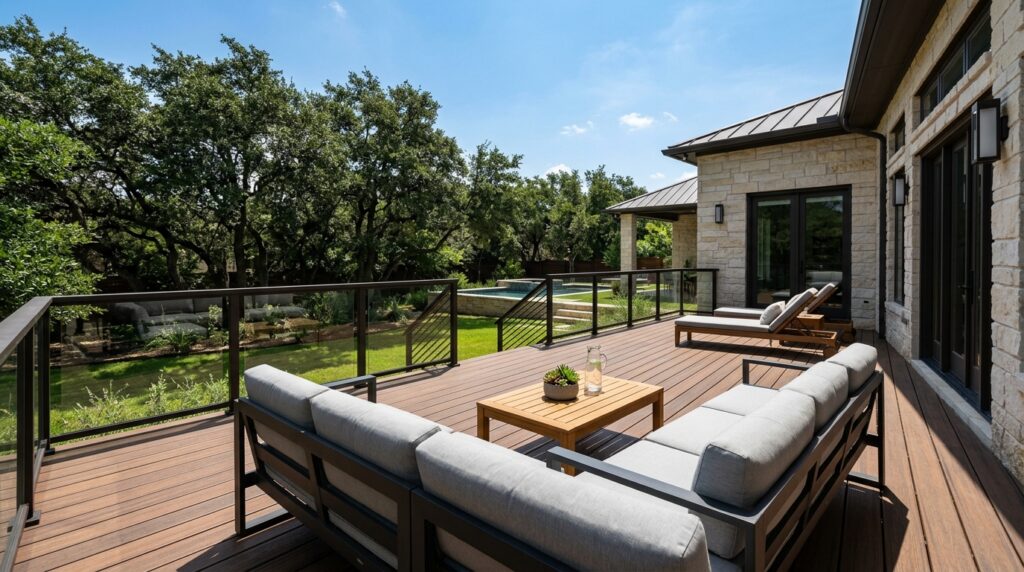
Most composite decking lasts 25 to 30 years. That figure is backed by manufacturer warranties and decades of field data from installed decks across the country. It’s not just marketing.
Capped boards — with a polymer shell bonded to all four sides — sit at the longer end of that range. High-end capped lines regularly reach the 30-to-50 range because the shell locks out UV rays, moisture, and the mold that degrades older products. Uncapped material, the earlier generation, typically falls in the 15 to 25 year window.
A standard pressure-treated wood deck lasts about 10 to 15 years before serious decay sets in. These decks outlast wood by a wide margin, which is why more San Antonio homeowners are making the switch when it’s time to rebuild.
The deck lifespan you actually get depends on more than the surface material alone. The substructure, the installation quality, and regular upkeep all play a role. We cover each factor below.
Warranties are one of the most reliable signals of expected durability. When a brand backs its decking for 25 to 50, that’s a calculated commitment, not guesswork.
Their capped lines add 25- to 50-year fade and stain coverage on top of the base structural warranty. The warranty documents from leading brands reflect genuine engineering standards built into every piece at the factory, and they’re worth reading before you buy.
One thing those documents often skip: coverage applies to the surface material itself, not the substructure underneath. That distinction matters when you’re evaluating the total value of the installation.
Capped composite boards from top brands are engineered to handle the conditions that age lesser products fast: UV exposure, temperature swings, and repeated moisture exposure. A properly installed composite deck in San Antonio’s climate can realistically last three decades or more. We’ve seen well-maintained installations hold up beautifully with nothing beyond occasional cleaning.
Not every composite deck ages at the same rate. Four factors drive the biggest differences: the type of product, the brand, the frame underneath, and how carefully it was installed. Get these right and the deck will serve you for decades.
This distinction matters more than almost any other factor. Capped composite carries a protective polymer shell on all four sides. That shell resists UV fade, dampness, and mold growth. Uncapped material — made from wood fiber and recycled plastic — lacks that protection and is more susceptible to staining, fading, and weathering damage as it ages.
If you want a composite deck that will last three decades or more, capped composite is the right call. The price difference between capped and uncapped is real, but so is the gap in durability when San Antonio’s climate is the stress test. Uncapped can still serve you well for 15 to 25 years with more attention.
PVC decking is a related option — it contains no wood fiber at all, making it the most moisture-resistant product available. The tradeoff is a less natural feel underfoot and a higher price point. For most homeowners, the premium capped option hits the sweet spot between long-term performance and everyday livability.
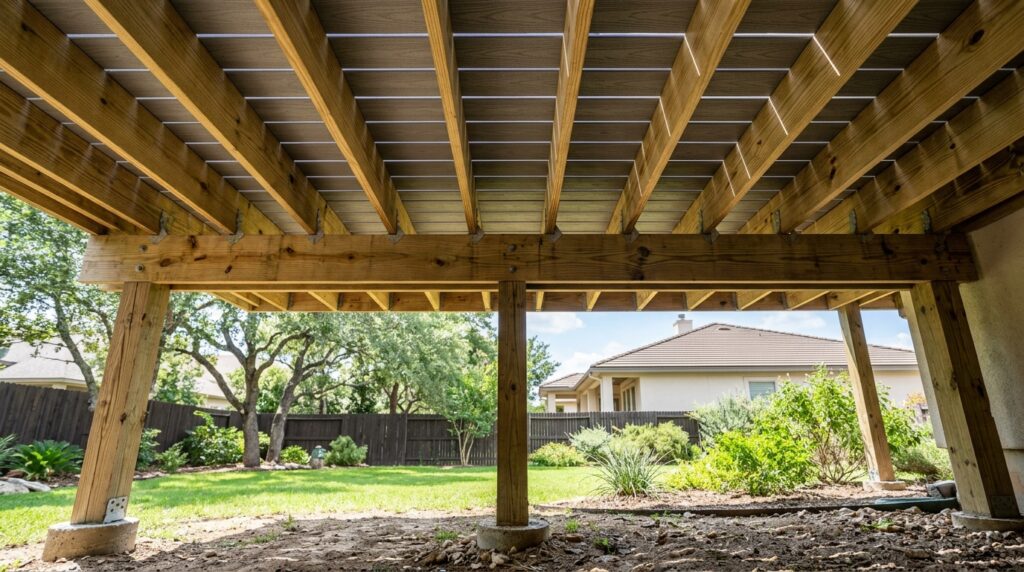
wood frame beneath them. The substructure — the joists, beams, and ledger — determines whether you need a full deck replacement or just a surface refresh after two decades of use.
A composite deck on a properly treated, well-ventilated frame can go a full two to three decades before any serious structural concern arises. But a deck built on undersized joists with poor drainage can develop frame problems well before the surface shows wear. Installation quality protects your investment as much as the product itself does.
Steel substructure systems eliminate frame rot entirely. They’re a premium option, but they can outlast both the decking boards above and the homeowner who ordered them.
National articles on how long decking lasts are written for a general audience, so the local details get lost. San Antonio has its own conditions, and any honest contractor here will tell you about them upfront.
The biggest factor is UV intensity. Texas gets more direct sun than most of the country, and that UV load is the primary aging accelerator for decking products — especially uncapped or older material. Fading and chalking are the telltale signs. Modern capped composite is specifically engineered to resist this. The polymer cap deflects UV before it reaches the wood-fiber core, which is why capped material holds its color so much longer than the earlier generation.
Temperature swings are the next piece. San Antonio summers push past 100°F for weeks at a stretch. The material expands and contracts with those extremes. Proper gapping at installation is what prevents buckling or binding during the hottest stretches. Correct fastener placement and gap spacing at install time is what protects the deck’s performance through decades of San Antonio weather cycles.
Humidity is worth mentioning too, though this material handles it far better than wood. In shaded corners of a San Antonio yard, surface mildew can appear. It’s cosmetic, not structural — a single cleaning takes care of it without shortening the life of the deck. For a broader look at options suited to this climate, our best deck materials for Texas heat and humidity guide covers the full picture.
Pressure-treated wood decks last roughly 10 to 15 years under typical conditions. Composite decks typically run 25 to 30 minimum, with capped products reaching well past 40. Over two or three full rebuilds of a wood deck, the capped option typically wins on total ownership cost — even with the higher upfront investment.
Natural wood has its place. If you love its look and are prepared to sand, stain, and seal on a regular schedule, a wood deck can be beautiful for its full service life. But that upkeep is recurring and real. Composite decking requires a fraction of that commitment. For a detailed side-by-side breakdown, see our wood vs composite decking comparison.
Wood is also more vulnerable in San Antonio’s climate. Humidity cycles, termite pressure, and UV intensity all accelerate decay here faster than in cooler or drier regions. Capped composite doesn’t rot, doesn’t warp from standing water, and doesn’t attract termites — three meaningful advantages in South Texas.
Low-maintenance isn’t the same as zero maintenance. A few consistent habits keep a well-built composite deck performing across its full expected service life — and often well beyond it.
The most important maintenance practice is also the most basic: keep the surface clean. Dirt, leaves, and debris trap moisture against the deck surface, which encourages mildew in shaded spots over time.
Clean composite decking with mild soap and water — dish soap works well. Use a soft-bristle brush and rinse with a garden hose. Never use a high-pressure washer on composite decking. High pressure forces water into the board structure and can degrade the cap layer over time. Abrasive cleaning tools scratch the finish and dull it permanently.
Keep the gaps between planks clear of debris. Blocked gaps prevent drainage and hold water against the frame below — that’s where rot starts. It’s a five-minute task that protects structural integrity as much as caring for the surface itself. Our team covers the full seasonal routine on our professional deck maintenance page.
Inspect the deck once a year. Look for planks that have shifted, fasteners that have loosened, and spots where water pools instead of draining. Good maintenance practices catch small issues before they become structural problems — that difference is what separates a composite deck that lasts 25 from one that runs 40.
The frame is the unsung variable in composite deck longevity. The surface can look flawless while the structure below deteriorates quietly. A few habits protect the frame over the long haul.
Airflow under the deck matters. If your deck sits close to the ground, ensure adequate clearance and ventilation — trapped moisture accelerates rot in the substructure. Flashing at the ledger board is equally important; water infiltration at the ledger is one of the most common causes of premature structural failure in any deck system.
Every few seasons, inspect the joists and beams for soft spots, discoloration, or insect activity. Catching a frame problem early can spare you a full rebuild and keep your existing decking in service for its entire lifespan. If something looks off, our deck repair team can assess whether it’s a targeted fix or something more involved.

A composite deck gives you a long runway before serious problems appear, but it isn’t indestructible. Knowing what to watch for helps you act at the right moment — fixing what can be fixed before it becomes a full rebuild.
Surface issues to keep an eye on:
Structural issues that need immediate attention:
Surface issues are usually cosmetic and manageable. Frame problems need professional attention promptly. In many situations, existing boards in good condition can be salvaged onto a rebuilt frame — a far more economical outcome than replacing everything at once.
When you look at total ownership cost, composite decking makes strong sense for most San Antonio homeowners. The upfront materials cost is higher than pressure-treated wood, but that gap narrows once you factor in what wood demands over time: repeated staining, sealing, plank-by-plank replacement, and eventually a full rebuild — all within a span that a well-built composite deck handles as a single continuous service life.
San Antonio’s climate is specifically hard on outdoor structures. Intense UV, heat that regularly pushes triple digits, and humidity swings put real stress on any deck. This product was engineered for exactly these conditions. It doesn’t require the constant intervention that wood does, and that’s genuine value in this part of Texas.
According to the manufacturer’s guide on how long decking lasts, capped composite products are designed to maintain structural integrity and appearance for decades with proper installation and basic care. That tracks with what we see here in San Antonio.
We’ve been building and maintaining decks in the San Antonio climate for a long time, and one pattern is consistent: homeowners who chose this material a decade ago are still enjoying the same surface, while neighbors who went with wood have already rebuilt once or twice. The durability advantage compounds over time.
If you’re ready to explore composite decking installation in San Antonio, the combination of long service life, minimal upkeep, and proven performance in Texas conditions makes it a sound investment for outdoor living. The team at our San Antonio deck builders can walk you through the right materials and design for your yard.
The main drawbacks are higher upfront cost and heat retention in direct sun. These materials cost more than pressure-treated wood to purchase and install. On hot Texas days, dark-colored boards hold heat underfoot — worth factoring in if you use the composite deck barefoot in summer. The trade-off most homeowners gladly accept: no rot, no splinters, no staining schedule, and a service life that outpaces wood by a wide margin.
Yes. Dawn dish soap and warm water is an effective cleaning solution for composite decking surfaces. Apply with a soft brush, scrub lightly, and rinse well. Avoid high-pressure washing, bleach-based cleaners on colored surfaces, and abrasive pads — all three can damage the cap layer or scratch the finish. Consistent, gentle cleaning is genuinely all most decks need to stay sharp year after year.
Quality composite decking — properly installed and cared for — rarely needs repair during its first 15 to 20 years. Issues that arise are typically fastener-related or involve the substructure rather than the surface itself. Inspect the composite deck annually and address small problems early. For most homeowners with a capped product from a reputable brand, the full maintenance commitment is a periodic cleaning and an occasional structural check.
All composite decking fades slightly in the first few months after installation — this is normal pigment settling, not UV damage. After that initial period, the capped option resists further color change well. Uncapped material is more vulnerable to ongoing UV damage and will show more color shift over time in the Texas sun. If fade resistance is a priority — and in San Antonio, it should be — choose a capped product and check what the decking warranty says about fade and stain coverage specifically.
Key Takeaway: Composite decking delivers a genuine 25 to 30 year service life under most conditions, with premium capped products regularly reaching 40 and beyond. In San Antonio’s demanding climate — intense UV, extreme heat, and humidity swings — capped composite outperforms traditional wood by a wide margin. The surface boards typically outlast the frame beneath them, which is why installation quality and substructure protection matter just as much as the product you choose. Keep it clean, inspect it regularly, and the deck will give you decades of outdoor living without the relentless maintenance cycle that wood demands.
Ready to talk about a composite deck built to last in San Antonio? Get a Free Estimate — call (210) 387-1286. The team at our San Antonio deck builders can help you find the right materials and design for your space.
Copyright © 2026 Prestige Deck Builder. All rights reserved.