You walk out back in late August and press your foot down near the ledger board. Last spring it felt solid. Now it gives slightly — spongy in a way that makes your stomach drop. That’s the moment most San Antonio homeowners start asking how long a wood deck really lasts, and whether they’re looking at a few repairs or a full rebuild. The answer depends on your wood species, how the structure was built, and whether you’ve kept up with care in one of the most punishing climates in the country.
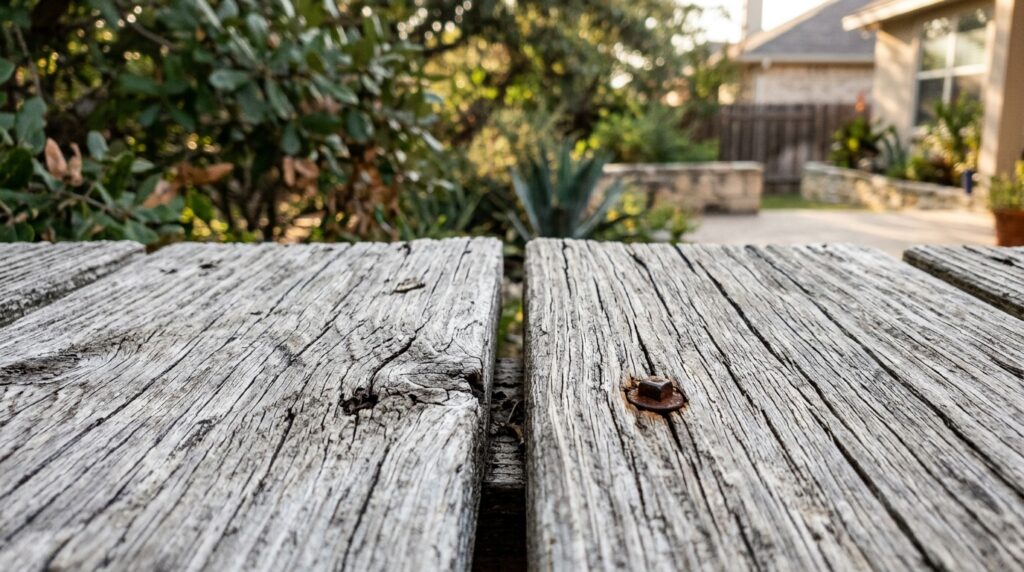
A wood deck typically lasts 10 to 15 years with standard pressure-treated pine and basic upkeep. Naturally durable species like redwood and cedar run 15 to 25 years when properly maintained. With a sound substructure, quality lumber, and consistent care, many years of service beyond those baselines are within reach. Some structures push well past 25 years.
Those ranges assume a reasonably well-built structure with joists properly spaced, adequate ground clearance, and a homeowner who seals or stains every two to three years. Skip the upkeep and you can cut those numbers nearly in half. We’ve seen platforms here in San Antonio that were less than eight years old but looked like they’d been out in the elements for twenty, simply because they were never sealed after the original install.
The wood species you start with matters enormously, but it’s not the whole story. A premium build that drains poorly and sits in standing water will fail faster than a modest pressure-treated pine structure that’s well-built and sealed on schedule. The deck material and the care you give it work together to determine real-world service life.
As a general rule: pressure-treated pine runs 10–15 years, naturally durable softwoods run 15–25 years, and tropical hardwoods like ipe can hit 25–40 years. These figures assume regular maintenance and a structurally sound build from day one. Neglect compresses every one of those ranges significantly in South Texas.
Not all lumber ages the same way. The species you choose at the start sets a ceiling on how long your deck can reasonably last, even with excellent upkeep. Here’s how the most common deck materials compare for a San Antonio homeowner.
Pressure-treated wood is the most common decking choice in South Texas, and for good reason. It’s widely available, handles moisture and UV punishment reasonably well, and treated wood can last 10 to 15 years with consistent sealing and staining. The treatment process guards the lumber against insects and fungal rot, which matters here where termites are a year-round concern rather than a seasonal one.
The tradeoff is that pressure-treated pine is a softer species more prone to checking, splintering, and surface cupping over time. This is especially true when boards go through the wet-dry and heat-cold cycles common in San Antonio. Left unfinished, the boards will gray, check, and absorb water faster than a denser species would. Seal it young and keep it sealed, and you’ll get the full service life out of it.
Cedar is the step up most San Antonio homeowners consider when they want a build that handles our climate more gracefully. It’s a naturally rot resistant species with oils in the wood that slow water absorption and hold up against decay without chemical treatment. A well-maintained deck built from this species typically runs 15 to 25 years, and we’ve seen structures push well past that when the substructure was solid and owners kept up with sealing every two to three years.
Redwood offers similar natural durability and is particularly valued for its dimensional stability. It warps less dramatically than pine under temperature swings. Sourcing quality redwood in San Antonio can be harder since it’s harvested primarily in the Pacific Northwest, but when you can get it, redwood’s service life rivals the best softwoods and sometimes exceeds them.
Ipe, teak, cumaru, and other tropical hardwoods are extraordinarily dense. Many are naturally durable against insects and weathering without any treatment at all. A properly installed tropical hardwood structure can last 25 to 40 years. The tradeoff is harder installation, special fasteners, and a need for oiling rather than standard staining to keep the wood from drying out and cracking in our intense summer heat.
San Antonio decks don’t age the way they do in Minnesota or Seattle. We have our own particular set of punishments, and understanding them is the first step to getting the full service life out of your investment.
UV radiation is the first assault. From late spring through early fall, we routinely see sustained stretches above 100°F with clear skies and intense sun. UV breaks down the lignin in wood — the binder that holds fibers together — causing surface graying and brittleness. Unprotected deck boards can show significant UV wear within a single Texas summer. A quality UV-blocking stain or sealant isn’t optional here. It’s basic protection against a climate that accelerates deterioration faster than most national guides account for.
Humidity swings add a second layer of stress. San Antonio sits at the northern edge of a humid subtropical zone. We get stretches of dry heat that pull water out of the wood, causing it to check and crack along the grain. Then a storm rolls through and the boards soak up water rapidly, expanding and stressing fasteners and joints. That repeated expansion and contraction causes cumulative structural damage even to well-maintained wood over time.
Then there’s the freeze factor most people forget until it happens again. The February 2021 winter storm is the obvious reference point. Structures that had never seen single-digit temperatures suddenly did, and the resulting harm showed up as cracked boards, failed fasteners, and popped connections. A deck with proper fastener spacing and boards that have room for thermal movement handles those events far better than a tightly-packed structure that can’t breathe.
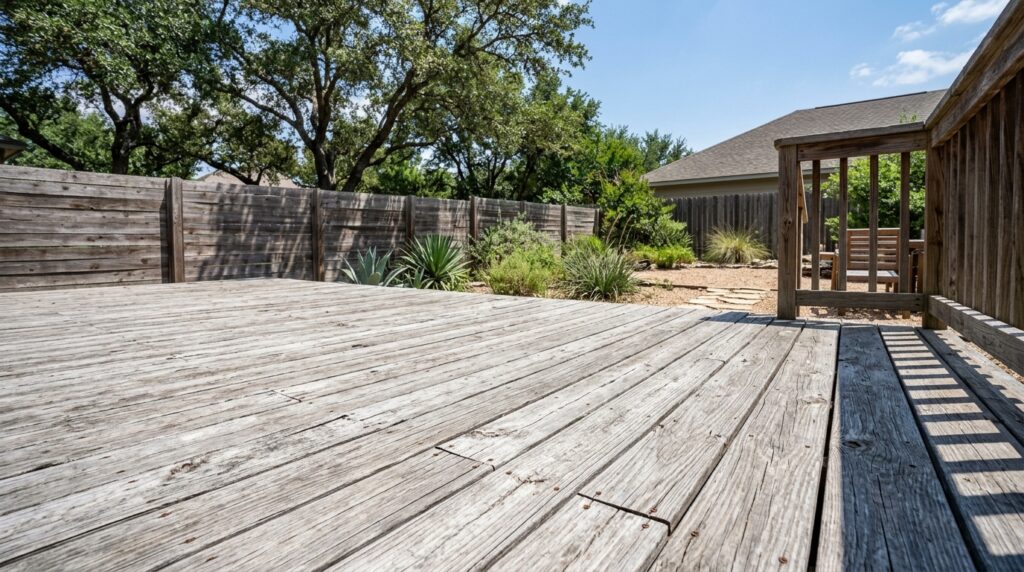
In our years building and restoring outdoor structures across San Antonio, we’ve seen the same culprits come up over and over. The deck that fails at year seven almost always has more than one of these issues working against it at the same time.
UV degradation and moisture intrusion don’t work in isolation. They amplify each other. UV breaks down the surface finish, making it easier for water to penetrate, which accelerates rot and eventual structural failure. Breaking either cycle through proper construction or timely upkeep breaks both.
Most of what shortens a build’s life is preventable. A consistent maintenance schedule doesn’t have to be complicated. It just has to happen on a Texas timeline, not the schedule printed on a national brand’s label. Regular maintenance here means tighter intervals than the packaging suggests.
Here’s the upkeep playbook that works for San Antonio’s climate:
Professional deck maintenance — cleaning, staining, and a thorough inspection — is worth scheduling every two to three years even if you handle the annual cleaning yourself. A trained eye catches early water damage, fastener corrosion, and ledger problems before they become structural emergencies.
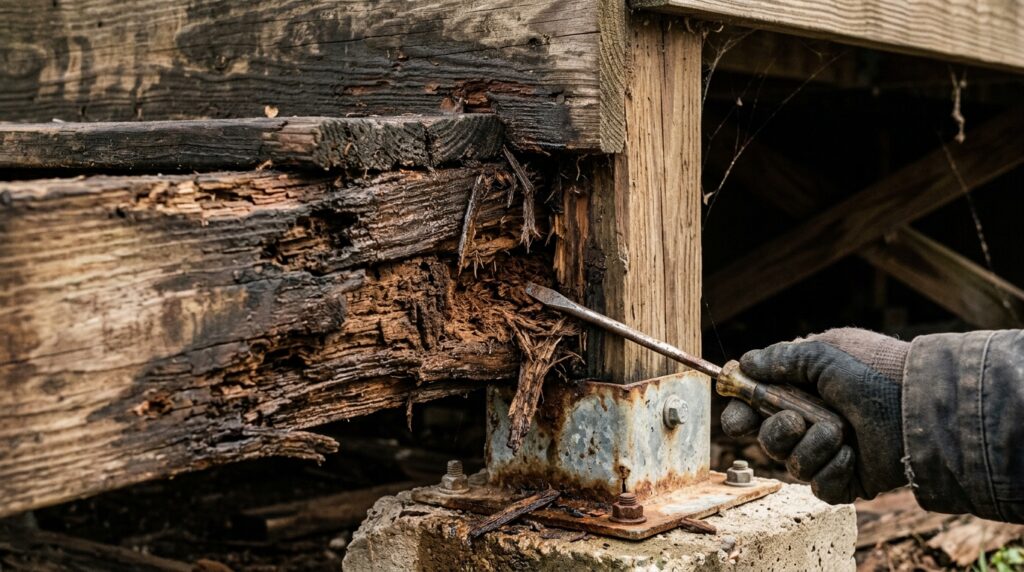
Most structures don’t fail all at once. They give warnings first. Homeowners who catch those signals early spend far less than those who wait until they become emergencies. Here’s what to look for:
The decision usually comes down to how far issues have spread into the substructure. Surface boards, railings, and even a section of joists can often be addressed with targeted work. When posts, beams, and the ledger are all compromised, a full rebuild is typically the more economical and safer path. A failing deck that gets patched rather than replaced tends to demand another round of work within just a few years.
It’s a fair question, and it deserves an honest answer. Man-made decking made from wood fiber and plastic typically carries manufacturer warranties in the 25-to-30-year range, and it delivers on low-maintenance performance in a climate like ours. It won’t gray, check, or need sealing, and quality composite boards handle UV and humidity cycles without the surface breakdown natural wood shows.
The real comparison between decking materials comes down to what you value and what tradeoffs you’re willing to make. Synthetic boards hold their appearance longer with less work. Natural wood — especially species with inherent rot resistance or tropical hardwoods — offers warmth, beauty, and repairability that manufactured decking can’t match. A damaged synthetic board typically needs full replacement; a damaged wood board can often be planed, sanded, or individually swapped out without the whole surface looking patchy.
For a pool deck, a synthetic option often makes sense because of constant water exposure and barefoot traffic. For a covered outdoor living space or pergola extension, a quality wood deck with consistent upkeep can be the more beautiful and equally durable choice. There’s no single right answer. The best decking material is the one that fits how you’ll actually use and care for the structure over time.
Plan for a realistic conversation about deck replacement somewhere in the 15-to-20-year range for a standard pressure-treated pine deck in San Antonio, or 20-to-25 years for a well-maintained structure built from naturally durable species. Those aren’t clocks. They’re planning horizons. A well-built, well-tended deck can push past those numbers; a neglected one may need attention significantly sooner.
The smarter question isn’t “how old is my deck?” but “what condition is my substructure in?” Surface boards can be replaced at almost any point. If the joists, beams, and posts are solid, you may get another decade out of the deck with a surface replacement and fresh sealant. If the substructure is compromised, deck replacement is the honest recommendation. Patching a failing foundation doesn’t extend real service life. It just delays the reckoning.
A professional deck inspection every five to seven years is a reasonable benchmark. Have someone who builds these structures for a living look at the ledger connection, post bases, joist condition, and fastener integrity — not just the surface boards. Our San Antonio deck builders offer free estimates that include a structural assessment, so you know what you’re actually working with before making a decision.
The 3/4/5 rule is a layout technique carpenters use to confirm that framing is perfectly square before the first board goes down. It’s based on the Pythagorean theorem: if you measure 3 feet along one framing member, 4 feet along the perpendicular member, and the diagonal between those two points is exactly 5 feet, the corner is a true 90-degree angle.
Why does this matter for a lifespan conversation? Because an out-of-square deck frame creates problems that compound over the years. Boards that aren’t running true to the frame gap unevenly, creating drainage problems and water traps. Railings and stairs that aren’t plumb to a square frame develop stress points that accelerate wear and damage over time. Structural integrity isn’t just about lumber grade. It starts with whether the framing was laid out correctly on day one.
For larger decks, builders typically scale the 3/4/5 method up — using 6/8/10 or 9/12/15 multiples to get a more accurate reading across a wider span. It’s one of those foundational checks that a competent builder does automatically and a rushed or inexperienced one skips. Skipping it costs nothing on build day and shows up as expensive problems five and ten years later.
Honestly — it’s rare for a softwood build, but not impossible. Standard pressure-treated pine hitting 30 years in San Antonio’s climate would require near-perfect construction, consistent sealing every one to two years, immediate attention to any rot or moisture issues, and a bit of luck with weather events. We’ve seen it, but it’s the exception, not what you should plan around.
For naturally durable species like redwood and similar dense hardwoods, 30 years is a more achievable target when the foundation is right and the upkeep is disciplined. Research on wood weathering from the USDA Forest Products Laboratory confirms that natural rot resistance varies significantly by species and that surface sealing dramatically extends service life. Both points support investing in better lumber and consistent care rather than hoping a budget build holds up three decades.
Tropical hardwoods like ipe genuinely can reach 30-plus years in the San Antonio climate. They’re dense enough to resist the checking and water absorption that damages softer species, and their natural oils protect against UV degradation from day one. If a 30-year deck is the goal, the conversation starts with species selection and substructure design, not just sealant brand.
A well-tended build using premium species, a solid substructure, and an owner who treats upkeep as non-negotiable is the realistic path to 30 years. It’s not effortless, but it’s achievable. Adding a covered structure — like a pergola overhead — dramatically reduces direct UV and rain exposure on the surface boards, which is one of the most effective longevity investments you can make for any outdoor living space.
Any deck in San Antonio lasts as long as the combination of its materials, its construction quality, and its maintenance allows. In our climate, that maintenance component carries more weight than almost anywhere else in the country. The deck lifespan you actually get is determined less by the calendar and more by the decisions made on day one and the care given every year after that.
If you’re not sure where your structure stands — whether it has years of life left or is approaching the point where the work no longer makes sense — the most useful thing you can do is get a professional set of eyes on the substructure. Surface boards tell part of the story; the joists, ledger, and post bases tell the rest.
Call us at (210) 387-1286 or reach out online to Get a Free Estimate. We’ll give you a straight answer about what your build actually needs — whether that’s a maintenance plan, targeted work, or a full rebuild designed to handle everything San Antonio throws at it for the next 20-plus years.
Copyright © 2026 Prestige Deck Builder. All rights reserved.