If you’re planning an outdoor living project in San Antonio, you’ve probably hit the same fork in the road most homeowners reach first: raised structure or ground-level surface? Both add usable outdoor space. Both add value. But they’re built differently, perform differently, and on a typical San Antonio lot with sloped terrain, heavy clay soil, and brutal summer heat, one option usually fits your situation better. This guide breaks down the deck vs patio decision the way a builder would, with honest trade-offs and the local context that actually matters here.
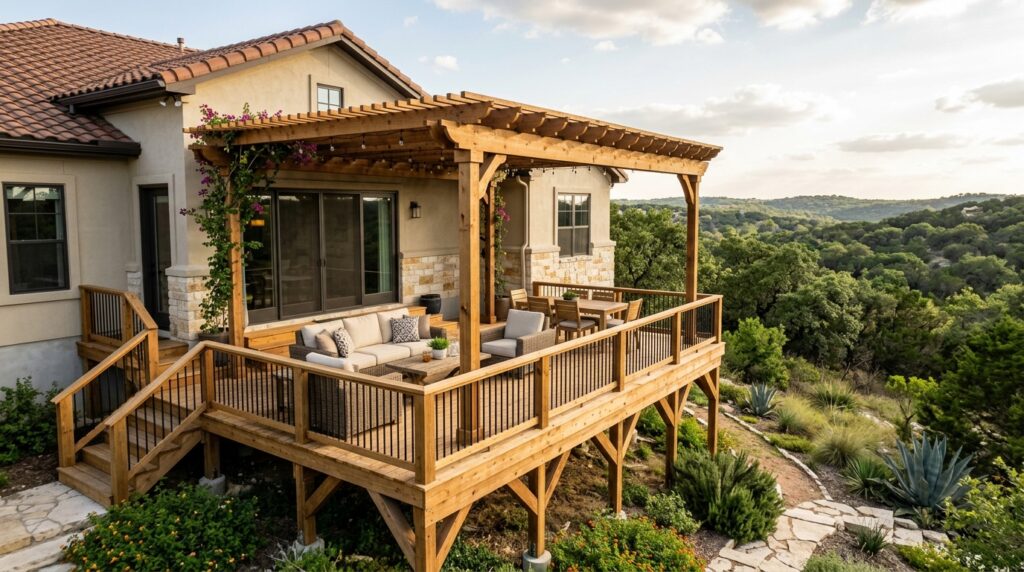
The distinction between a deck and a patio comes down to three things: elevation, material, and structure. A deck is a raised, framed platform built on posts and beams, usually attached to the house, lifted above the ground. A patio is a ground-level surface poured or laid directly on the earth, with concrete, pavers, stone, or brick sitting flat at grade.
That single contrast drives nearly every other trade-off: cost, how long it lasts, drainage, and long-term maintenance. In San Antonio, it matters more than it does in most cities. The terrain and soil here create conditions that favor one option significantly on many properties. Choosing a deck or patio isn’t just a style preference. It’s often a practical decision your lot makes for you.
A raised, framed outdoor platform sits on concrete piers driven into the ground below the active soil zone. The frame, typically pressure-treated lumber, supports the top surface boards. Those boards are either natural wood or composite material engineered to resist moisture, insects, and UV fading. The structure attaches to the house through a ledger board, making it an extension of the home rather than a freestanding addition.
Because it sits above grade, this type of structure handles grade changes naturally. If your backyard drops two, three, or even five feet from the house, the frame gets taller as the ground falls away. You get a flat, usable surface at door height without moving a single cubic yard of dirt. It also creates airflow beneath the boards, welcome during Texas summers, and allows rainwater to drain freely underneath rather than pooling at your foundation.
Material choice on the top surface is a major design decision. Wood vs composite decking is one of the first questions our clients face. Cedar, redwood, and pressure-treated pine carry a natural look and lower upfront cost on materials, but they require staining or sealing every one to two years to survive San Antonio’s heat. A composite deck costs more upfront but needs almost no ongoing upkeep, making it the smarter long-term investment for most homeowners who plan to stay in place.
A ground-level outdoor surface is poured or laid directly on a prepared base, compacted gravel, sand, or a concrete slab. The most common materials are poured concrete, paver units, natural stone, and brick. A patio is poured at grade and fairly straightforward: forms are set, the slab is finished, done. A paver patio takes more labor, as each unit is set individually on a leveled sand bed, but it offers flexibility in pattern, color, and future repair that a solid slab can’t match.
When the lot is flat and the soil is stable, a patio generally costs less than a comparable deck. There’s no framing, no ledger board, no posts, just a hardscaped surface at existing grade. This works especially well when you want to anchor heavy features on the ground: an outdoor kitchen, a fire pit, a large dining set. Patios usually cost less than a deck to build, and for the right lot, they’re the practical choice.
Brick and stone add a design flexibility that poured slabs can’t match. Individual paver units can be reset or replaced if one cracks or settles. You get a ground-level outdoor living space with more character than plain gray concrete, though a basic slab remains the most budget-friendly starting point.
On upfront cost, a poured slab is usually the lower option when your lot cooperates. Decks cost more to build than patios because they require a structural frame, footings, boards, railings, and typically a permit. The more elevation you need, the more framing goes in, and the price climbs accordingly.
But the initial price doesn’t tell the whole story. Ongoing upkeep over ten or fifteen years shifts the comparison. A wooden deck requires regular staining and sealing, plus board replacement as wear accumulates. Skip a few cycles in San Antonio’s sun and you’ll see boards gray, splinter, and eventually rot at fastener points. A quality paver surface or engineered composite boards both reduce the long-term maintenance burden significantly. Patios are generally more affordable than decks to start, but factor in the full picture before deciding.
Whether you build a raised structure or a paved surface, you’re adding something San Antonio buyers notice. A sagging timber deck or a cracked, uneven patio hurts resale more than it helps, so quality installation matters regardless of which direction you go.
This is where local conditions matter most, and where the distinction between a deck and a patio becomes especially clear. The soil across much of San Antonio and Bexar County is expansive clay. It swells when wet and contracts when dry. Over a year’s worth of seasonal cycles, that movement is significant. A slab poured directly on clay will crack. It’s not a matter of if, but when and how badly.
A raised structure on drilled piers doesn’t have this problem. The piers anchor into the ground below the active soil zone, in stable material. The frame and boards above float entirely clear of the clay movement. That soil can expand and contract all it wants, and the structure above doesn’t move with it. This is one of the clearest reasons building a deck in San Antonio is often the smarter structural choice on a typical lot, even when a patio looks less expensive on the initial estimate.
Drainage is the second local resilience factor. San Antonio gets intense rainfall, the kind that sends water sheeting through neighborhoods fast. Water flows freely under a raised structure and away from the foundation. A ground-level surface that isn’t graded precisely will pool water, push it toward the house, or simply sit underwater after a hard storm. Proper patio drainage is achievable, but it adds complexity many homeowners don’t anticipate upfront.
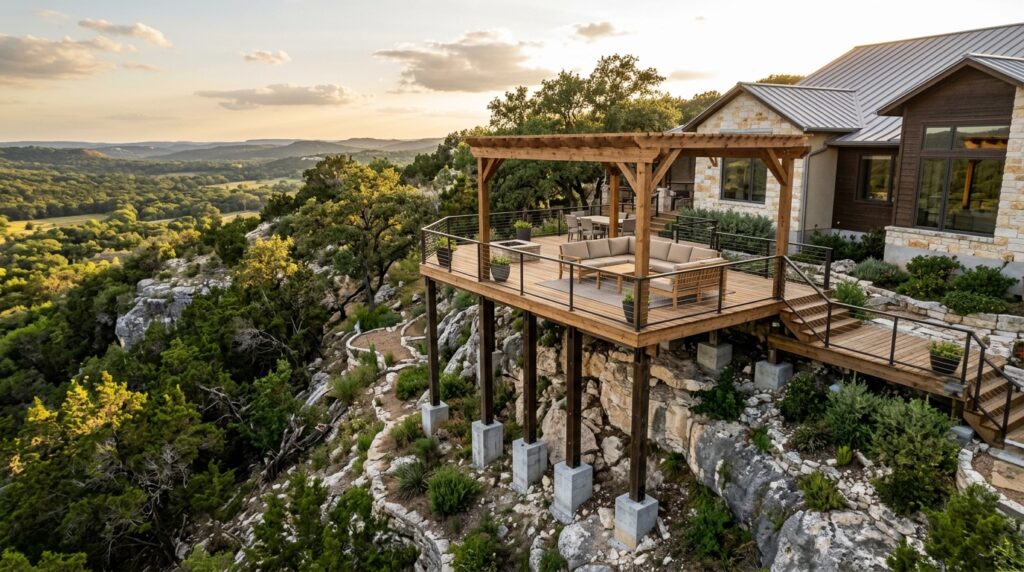
For homeowners in the Hill Country transition zone, Boerne, Helotes, Leon Valley, and areas northwest of the city, rocky terrain adds another wrinkle. Excavating for a patio base in solid limestone is expensive. Piers for a raised structure can be drilled into rock with standard equipment. In those areas, the raised option is often cheaper, not just structurally sounder.
Material choice drives the biggest maintenance gap. A wood deck needs annual inspection and cleaning, plus staining or sealing every one to two years. It’s manageable, but it’s recurring work you have to schedule and budget for over the life of the structure.
A composite deck dramatically reduces that workload. Composite decking doesn’t need staining or sealing. An annual wash keeps it looking clean. The pressure-treated frame still needs periodic inspection for moisture and pest activity, but that’s true of any structure. The higher upfront cost pays back over time by eliminating the recurring refinishing cycle.
A poured slab requires the least active upkeep, assuming it stays intact. Sweep it, hose it down, done. The problem arrives when clay soil movement causes cracking, and on San Antonio soil, that’s more a question of when than if. Paver surfaces handle this better: individual units can be reset or replaced without tearing out the whole surface.
Your lot’s topography is often the deciding factor in San Antonio. Flat lot with stable soil and a door that opens at grade? A ground-level surface makes sense and installs straightforwardly. Sloped yard that drops away from the back door? A raised structure built on a frame is almost always the better fit, and often the only practical option without major excavation and grading work.
Building a retaining wall to create a flat area on a sloped lot is possible, but you’re essentially constructing two projects: the wall to hold the grade and the surface itself. On many San Antonio lots, that combination runs higher than a well-built raised structure would, and it disrupts a lot more of the property during construction.
A raised structure built on posts handles a sloped lot naturally. The posts get longer as the grade drops, the frame stays level, and the top surface meets your back door at exactly the right height. You preserve your trees, your natural grade, and your existing landscaping without moving large amounts of earth. For the sloped lots common in neighborhoods like Alamo Heights, Terrell Hills, and Monte Vista, this is the approach our San Antonio deck builders recommend most often.
A flat lot gives you full flexibility. Both options work structurally. The decision comes down to budget, aesthetics, and how you plan to use the space. Outdoor kitchen anchored at grade? A solid paved surface may serve you better. Want a raised view, a breezy afternoon spot, a place that feels like an extension of the interior? The raised structure wins that conversation.
San Antonio buyers expect usable outdoor living space. The climate, despite the heat, is part of why people move here, and a well-designed backyard is a genuine selling point. Both a raised structure and a paved surface contribute to resale value when built and maintained well. The question is which fits your lot and your neighborhood’s buyer expectations.
Covered spaces add the most resale appeal. A raised structure paired with a pergola for shade creates an outdoor room buyers can picture using year-round, morning coffee in March, shaded gathering in August. A covered patio does the same at grade. The cover is what makes any San Antonio outdoor area livable through the worst of summer.
A pool deck around an in-ground or above-ground pool is one of the highest-value outdoor investments on a San Antonio property. Pool ownership is common here, and a clean, slip-resistant surface around the water is expected by buyers. For homeowners who want maximum indoor-outdoor connection, a screened-in porch takes the concept further, a genuine three-season living space that adds square footage to the home’s functional footprint without the cost of a full room addition.
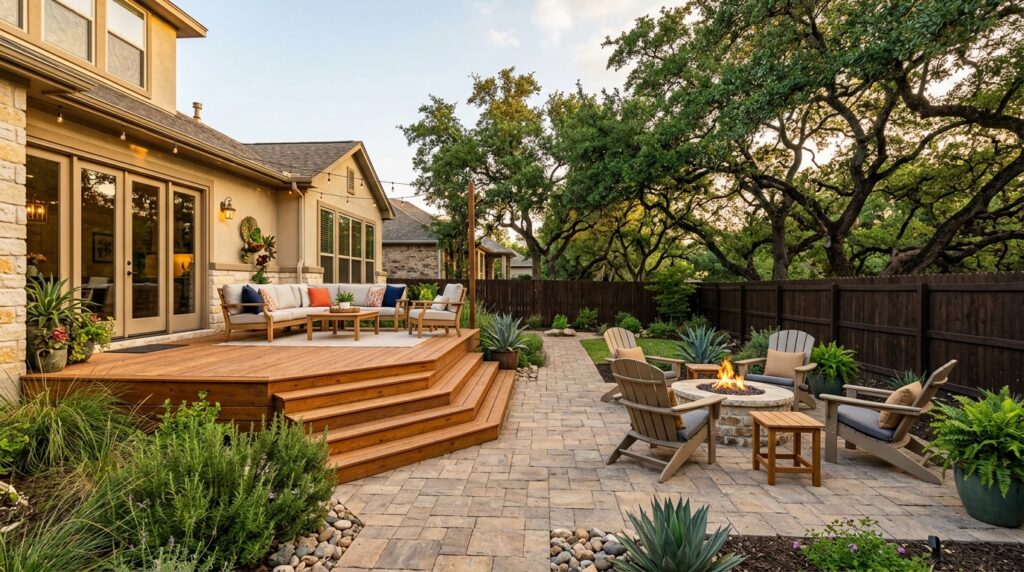
On many San Antonio lots, the best answer to the deck vs patio debate is: build both. A raised structure off the back door, combined with a paved surface below connected by stairs, makes exceptional use of a sloped lot. The upper platform handles the grade change and gives you a breezy outdoor room. The lower surface becomes the social hub, fire pit, outdoor kitchen, dining area at grade.
This setup is particularly common where lots drop three or more feet from the house to the back fence line. The upper structure handles the grade transition. The lower surface becomes the gathering space. Both work independently. Together they turn a tricky sloped lot into a multi-level outdoor living design that homeowners and buyers both love.
Add a pergola over the upper level for shade, a planting bed along the lower edge for definition, outdoor lighting, and built-in seating, and these details add up to a space that gets used every week. Our team has spent years building decks and outdoor living spaces across San Antonio, and a combined approach is one of our most common recommendations on lots with any significant grade change. Check out our guide on best deck materials for Texas heat and humidity to inform your material choices once you’ve settled on direction.
There’s no universal right answer. It depends on your lot, your priorities, and your budget. If your lot is sloped, your soil is heavy clay, or your back door sits well above grade, a raised structure built on piers is almost certainly the better fit. If the lot is flat and stable and you want the lowest upfront cost for a simple outdoor surface, a paved ground-level option makes sense. Choosing a deck or patio really comes down to what your specific lot demands and what you plan to do in the space.
No. A patio is not the same as a deck. The difference between deck and patio is elevation, material, and structure. Patios are poured or laid at ground level, concrete, pavers, or brick sitting on the earth. A deck is a raised, framed structure elevated above the ground, usually attached to the house. They serve similar purposes but are built completely differently and perform differently depending on your lot conditions. For additional perspective, you can read about the difference between a deck and a patio from TimberTech as well.
In most cases, a paved surface at grade carries the lower starting cost, especially a basic slab on a flat lot. A raised structure runs higher because of the framing, footings, boards, and railings involved. On a sloped lot, the calculation changes: adding a garden wall or excavation to create a flat base can close the gap or flip it entirely. Long-term upkeep for a standard deck adds up in ways that a well-built paver patio or engineered boards won’t. Get specific estimates for your lot before assuming one option is automatically cheaper.
If your lot is flat and your budget is limited, start with whichever option fits your terrain. If the lot is sloped and your door sits above grade, a raised structure is likely your practical starting point. If you have the budget and the lot supports it, combining both, a raised platform at door height with a lower surface connected by stairs, gives you the most functional outdoor living setup on a sloped lot. Our team at Prestige Deck Builders of San Antonio has built that combination across the city many times, and homeowners consistently say it’s the part of their outdoor project they use most.
Bottom Line: On a San Antonio lot, your soil, your slope, and your back door height often make the decision for you. A raised structure on piers handles clay soil movement, sloped terrain, and drainage in ways a ground-level surface can’t match. A paved surface at grade is the right call on flat, stable lots where upfront cost is the priority. For many homeowners, the smartest outdoor investment is both, a raised platform off the house with a lower surface below, designed to work together. Either way, build it right the first time and you won’t be replacing it in five years.
Ready to figure out what fits your yard? Get a Free Estimate from our team, or call us directly at (210) 387-1286. We’ll look at your lot, talk through your options honestly, and give you a clear picture of what makes sense for your home.
Copyright © 2026 Prestige Deck Builder. All rights reserved.