You’ve got a backyard in San Antonio and you’re deciding between pavers and poured concrete. Both show up on every contractor’s pitch sheet, but they don’t perform the same. Not here, where the clay shifts, the sun is relentless, and the rain comes in sheets. This guide breaks down the real differences so you can choose wisely before a single shovel hits the ground.
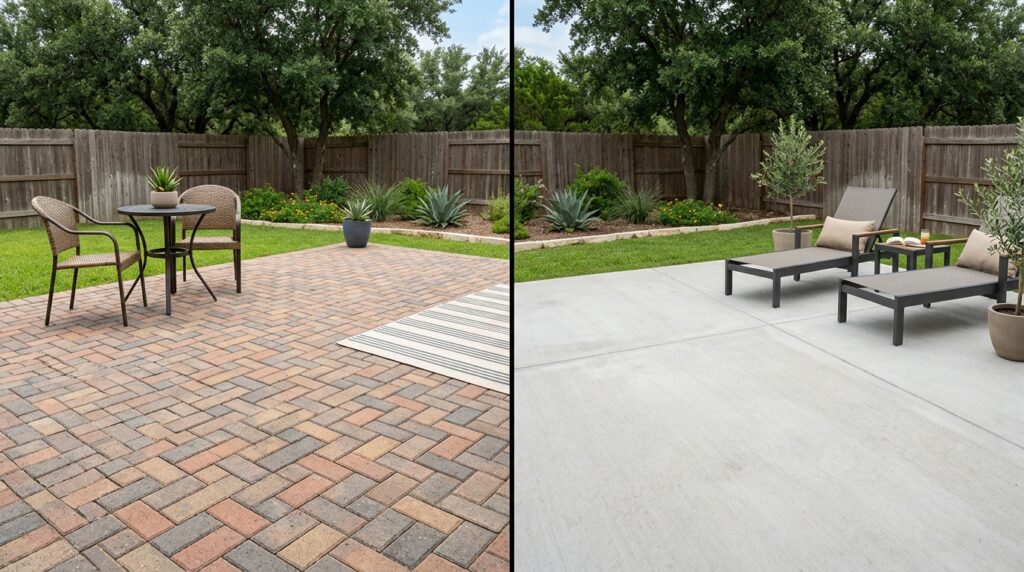
When it comes to pavers vs concrete patio decisions in San Antonio, the short version is this: concrete is the lower-cost option upfront and installs fast, but pavers win on durability, water management, repairability, and long-term curb appeal — especially on San Antonio’s notoriously shifty clay soil. If your budget allows, pavers are usually the smarter long-term investment here. Working with a tighter budget? Poured concrete gets you a solid surface today, but plan for cracks and repairs down the road.
A poured concrete surface goes in as one continuous slab. The mix spreads across the prepared base and cures into a single rigid field. It’s a straightforward process, and that simplicity is a big part of its appeal.
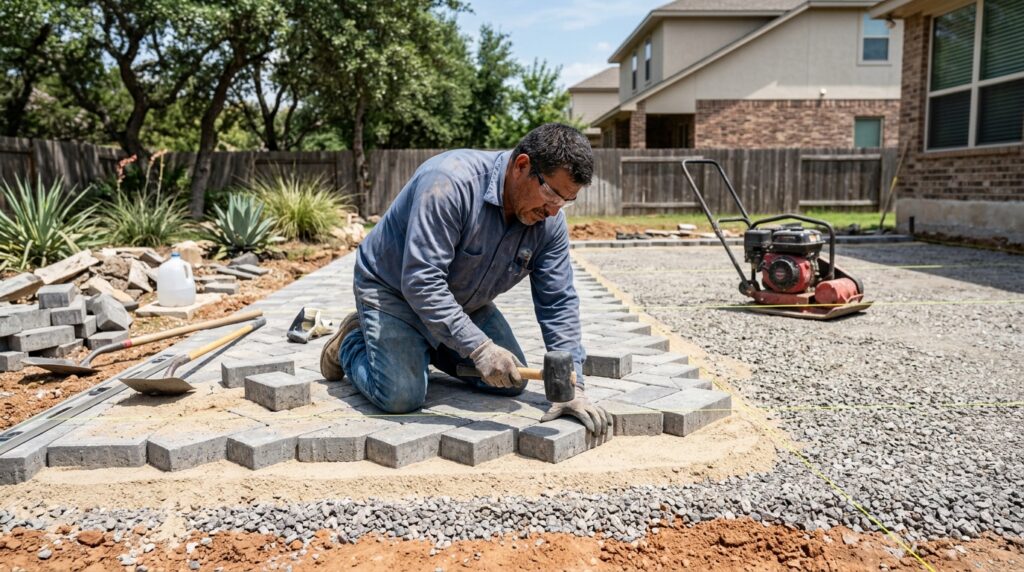
A paver surface is built from individual units: concrete pavers, brick, or natural stone laid over a compacted gravel and sand base. Each piece sits independently, so the surface can flex as a unit rather than cracking apart like a monolithic pour.
That structural difference matters more in San Antonio than almost anywhere else in Texas. The clay expands when wet and contracts when dry, putting constant pressure on anything poured rigid into the ground. Read about the best materials for Texas heat and humidity for a broader picture of how the local climate shapes every outdoor surface choice.
San Antonio sits on expansive shrink-swell clay soil. That clay absorbs moisture and swells, sometimes dramatically, then contracts again as it dries out. A poured slab is rigid, so when the ground underneath heaves and settles, the concrete has nowhere to go. It cracks. Not if, but when.
Control joints delay the inevitable, but they don’t eliminate the problem. Homeowners throughout the area know the frustration: a surface that looked perfect the first summer starts showing hairline fractures by year two or three. Those cracks widen, collect weeds, and become a trip hazard.
The pavers behave completely differently. Because each unit is independent, the surface moves with the clay instead of fighting it. If one section heaves slightly, neighboring pavers absorb the movement rather than transmitting stress across a rigid span. Interlocking pavers spread load across the base, making the whole surface more forgiving when the ground is doing what San Antonio clay does.
Stamped concrete deserves a mention. It mimics the look of pavers at a lower cost, but it’s still a poured slab underneath the pattern. It cracks the same way plain concrete does, sometimes worse because the decorative surface shows damage more visibly. Comparing pavers and concrete from a manufacturer’s perspective confirms that pavers are significantly stronger than stamped concrete when it comes to withstanding ground shifting over time.
San Antonio weather doesn’t ease you into rain. It delivers it all at once. Flash-flood downpours are common enough that drainage isn’t a luxury consideration; it’s a practical one. Where water goes off your patio directly affects your foundation, your yard, and your family’s safety.
A solid slab sheds water as surface runoff. That water goes somewhere, usually toward your home’s foundation or into your landscape. If the surface isn’t pitched right, puddles form and linger. Poor water flow from a solid slab can undercut your foundation over years of heavy rain cycles.
Permeable pavers work differently. The joints between individual units allow water to filter down through the base rather than pooling on the surface. During the kind of sudden, intense storms San Antonio gets regularly, water infiltrates the ground instead of racing across your yard or backing up toward your house. Paired with a properly graded base, a paver surface can dramatically reduce runoff on your property.
The water management advantage isn’t limited to storm events. Everyday irrigation drains more cleanly through a paver surface, cutting down on the slippery conditions that standing water creates on a smooth slab.
Concrete patios usually cost less upfront. The material is widely available, installation moves quickly, and the job typically wraps faster than laying individual paver units. If budget is the primary constraint, poured concrete is the least expensive option to get a functional patio built fast.
Pavers cost more to put in. Materials run higher, and the base preparation, unit setting, and joint finishing take more skilled labor. That added cost is real, and it’s the main reason some homeowners default to concrete.
The math shifts in the long game. Concrete repairs are expensive and rarely look right. A patch never quite matches the original pour, and a cracked slab often means grinding it out and starting over. With a paver surface, a damaged unit is lifted and swapped with a matching piece. Invisible fix, fraction of the cost. Over ten to fifteen years, laying pavers frequently costs less in total than repeated repairs and eventual slab replacement.
Curb appeal adds another layer. A well-built paver patio that integrates with garden walls, a pool deck, or other outdoor living features signals quality that translates to real hardscape value when it’s time to sell.
Poured concrete is low-maintenance in the early years. Sweep it, hose it down, seal it every few years. The trouble starts when cracks appear, which they will on San Antonio’s expansive clay. Repair is where homeowners discover how unforgiving the material truly is.
Pavers require slightly more routine attention. Sand between the joints needs replenishing periodically as it settles or washes out, and sealing every two to three years keeps the surface looking fresh and locks the joint material in place. Weeds can sprout in neglected joints, but routine sealing prevents that. It’s a simple, predictable maintenance schedule.
Repairability is where pavers really pull ahead. When a single paver cracks or shifts, it’s pulled and replaced. Clean, fast, undetectable. That ease of repair keeps a paver patio sharp for decades with modest upkeep — something a poured concrete surface on San Antonio ground simply cannot promise long-term.
A standard pour offers a few basic looks: plain gray, broom-finished, or exposed aggregate. Stamped concrete expands those options with patterns and color, but it still cracks like any other slab. Color on stamped concrete fades faster than on quality paver units, especially under San Antonio’s UV intensity.
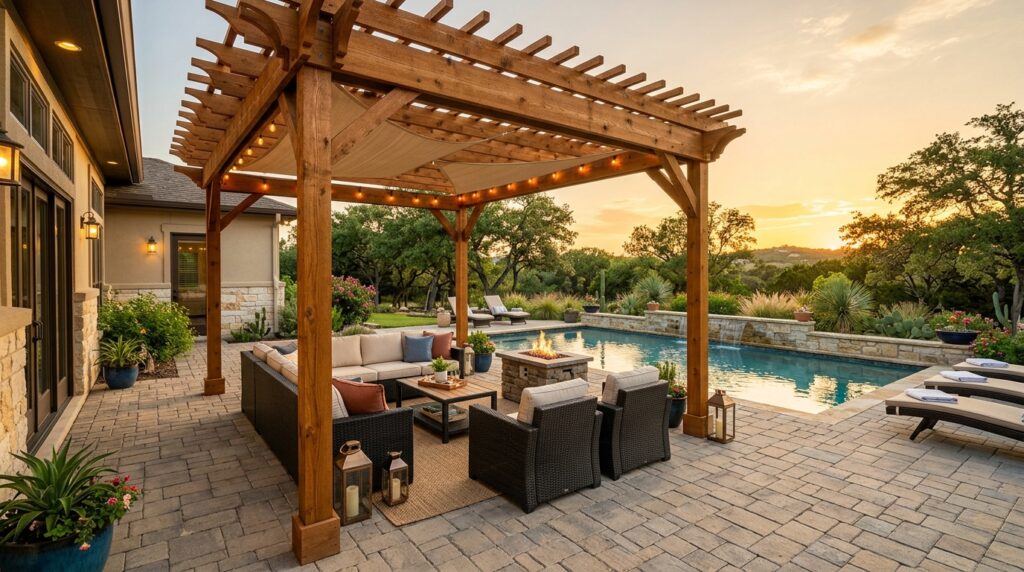
Patio pavers open up a much wider range of design possibilities. They come in dozens of shapes, sizes, and colors. Brick offers a warm, classic look. Natural stone — travertine, flagstone, limestone — gives a high-end finish that pairs beautifully with San Antonio’s Hill Country aesthetic. You can mix materials, vary patterns, and create transitions between zones in your outdoor space.
That design flexibility matters when you’re thinking about your patio as part of a larger landscape. A paver surface integrates naturally with low walls, planting beds, and walkways in a way that a plain slab rarely does. It coordinates well with a pergola for shade over your patio, a screened-in porch, or a deck structure, so the finished space feels pulled together instead of pieced together.
Color holds up well too. Quality concrete pavers are color-through: the pigment runs the full depth of the unit, not just the surface. A good seal coat keeps them looking vibrant year after year, even in the Texas heat.
Texas sun is hard on outdoor surfaces. A concrete slab absorbs heat all day and radiates it back in the evening. Anyone who’s walked barefoot across a paved surface in July knows that. Thermal expansion also drives stress cycles that wear on a rigid slab over time.
Pavers handle heat expansion more gracefully because the joints act as relief points. There’s no internal stress building across a rigid field because there is no rigid field. It’s a collection of independent units with built-in give.
The February 2021 hard freeze is worth remembering too. San Antonio saw record lows that stayed well below freezing for multiple days. Freeze-thaw cycles are brutal on rigid concrete because water that penetrates cracks expands as it freezes, widening the damage. Paver surfaces with proper joint sand and sealing handle freeze events better because the joints flex and individual units don’t carry tension across a wide span.
Across Texas heat, UV, and occasional hard freezes, pavers consistently outperform a poured slab. Their slip resistance is worth noting too. Textured surfaces stay safer underfoot when wet than smooth concrete, which matters especially around pool areas. See pool deck ideas that work in Texas for a closer look at how pavers perform in high-moisture settings.
For most San Antonio homeowners, yes. A paver patio is the better long-term choice when the budget allows. Expansive clay, intense UV, flash-flood rainfall, and occasional hard freezes all combine to make a flexible surface dramatically more resilient than a poured slab in this specific climate.
That said, a poured slab isn’t the wrong call for every situation. If you need a functional outdoor surface quickly and the budget is tight, a well-poured concrete surface with proper control joints will serve you for years. Just go in with clear eyes about the maintenance and eventual repair costs on San Antonio ground.
The masonry and outdoor surfaces you choose should match how you plan to use the space. A patio off a back door has different demands than one connecting to a pool area. A space anchoring a full outdoor area with a deck structure, a pergola, and a planted landscape deserves materials that hold up and look great for decades.
At Prestige Deck Builders, we’ve spent years building outdoor living spaces in San Antonio’s climate. We’ve seen how different surfaces perform through the heat cycles, the storms, and the ground shifting that define this region. Whether you’re thinking about a wood or composite deck, a pool deck, a pergola, or an outdoor room that ties it all together, we help homeowners make smart decisions, not just quote what’s easiest. Our San Antonio outdoor living team is ready to talk through your options.
Poured concrete is the lower-cost option to install. Materials are less expensive and the process moves faster, cutting labor hours. If upfront budget is the main constraint, a concrete slab gets you a functional surface for less money today. Pavers cost more to put in but typically cost less over a decade or more when you factor in repairs, replacement, and added property value.
Yes. Paver joints and the sand between them allow water to filter down into the base rather than running off the surface. This makes a real difference during the heavy rain events San Antonio sees regularly. A properly installed paver surface with good base preparation handles water flow better than a solid slab, reducing runoff toward your foundation and pooling in your yard.
Rarely, and when it does, the fix is simple. Individual paver units can crack under very heavy concentrated loads, but a paver surface as a whole absorbs ground shifting without transmitting stress across a wide span. When a single unit is damaged, it’s replaced. There’s no invisible repair problem and no risk of the damage spreading the way a crack in a poured slab does.
A well-installed paver surface outlasts concrete in San Antonio’s conditions. Concrete slabs on expansive clay typically start showing significant cracking within five to ten years. A quality paver installation, properly sealed and maintained, can look excellent for twenty-five to thirty years or more. The ground shifting, UV exposure, and occasional freeze events that shorten a slab’s life are the same forces that pavers are specifically built to handle. For long-term durability in this climate, pavers win clearly.
Bottom line: In San Antonio, the clay, Texas heat, and flash-flood rain events all point toward the same answer — pavers hold up better, drain better, repair more cleanly, and look better longer than a poured slab. The poured slab is the budget pick for today; pavers are the smart pick for the next twenty years. Whatever surface you choose, make sure it’s part of a well-planned outdoor living space that works for how your family actually uses the yard.
Ready to talk through your patio and outdoor living plans? Get a Free Estimate from Prestige Deck Builders of San Antonio — call (210) 387-1286 today.
Copyright © 2026 Prestige Deck Builder. All rights reserved.