Picture a backyard that slopes away from the house: six, eight, maybe twelve feet of drop across the width of the lot. If you build a single flat deck off the back door, you end up with a platform floating awkwardly over empty air or a pile of posts sunk so deep it looks like scaffolding. That’s where multi level deck ideas come in. A multi-level deck works with your grade instead of fighting it, stepping down the slope in a way that actually makes sense for how a family uses the yard. Multi-level decks are one of the most practical solutions for the rolling terrain across Bexar County, the Hill Country edge communities, and even the gentler grades inside Loop 1604.
San Antonio throws a few curveballs that other parts of the country skip entirely. The brutal UV from a South Texas summer warps and fades the wrong materials in a hurry. Mosquitoes and humidity make an unprotected lower level miserable from May through October. Backyard water features are practically standard issue in this city, and a tiered structure frames them better than almost any other design. Add all that up and a multi-level deck stops being a luxury upgrade. It becomes the smart call.
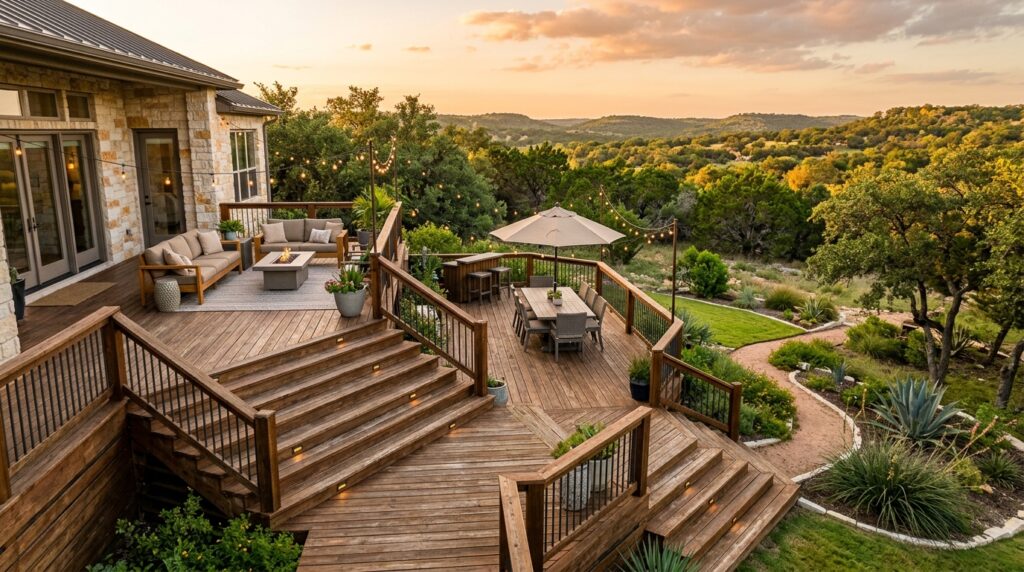
We build a lot of these on Hill Country lots where the grade drops off fast behind the house. Sometimes three feet in the first fifteen, then another five or six as you move toward the back fence. A tiered deck design reads that slope as an asset. Each platform sits at a natural elevation that matches how the land already wants to behave, so the structure doesn’t look forced into the ground.
The tiers can be as simple as two connected platforms at different heights, or they can stagger across three or four levels as the yard keeps dropping. Each tier becomes its own zone: one for grilling and dining close to the back door, one for lounging below, maybe a third that transitions into the lawn. The transitions between tiers are what make or break this kind of design. Wide steps with generous landings keep the flow comfortable and prevent the whole thing from feeling like a fire escape.
A split-level deck is the subtler version of a tiered build. Instead of dramatic elevation changes, you get a modest step, eight to fourteen inches usually, that defines two distinct zones on what is essentially one deck footprint. The step-down dining zone is a classic application of this. You come out the back door onto the main platform, then drop down a single riser into a slightly lower seating and dining area framed on two or three sides by the upper level’s fascia boards.
This kind of design does something a flat deck can’t: it creates a sense of arrival. The dining zone feels like a separate room even though it’s ten feet from the kitchen door. That elevation break also gives you a natural spot for built-in benches along the riser, recessed lighting under the step edge, and planters that sit flush at upper-level height without blocking sightlines. On a flat San Antonio lot, a split-level deck can manufacture that layered feeling without needing any slope at all.
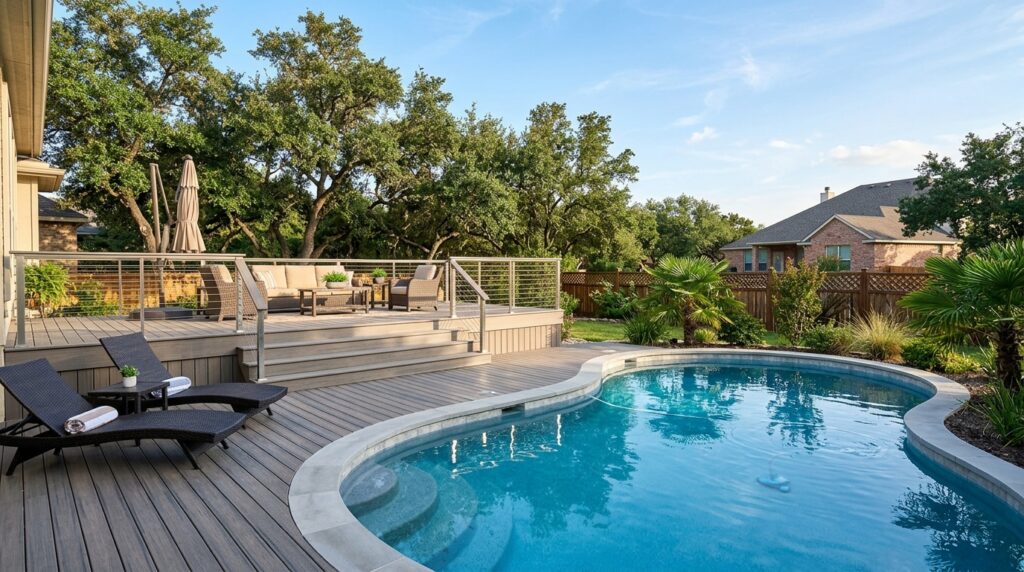
San Antonio homeowners with a pool face a familiar conflict: you want the deck to serve the water and the house at the same time. A two-level deck solves that cleanly. The upper level sits at the interior floor height and handles everyday traffic including morning coffee, weekend grilling, and a clear path to the yard. The lower level wraps the swimming area, stays wet-friendly, and keeps the splash zone away from the dining furniture.
Our pool deck builds in San Antonio often combine pressure-treated framing with composite decking on the surround, because those boards handle chlorine splash and standing water far better than unprotected wood. The elevation change between the two tiers gives you a built-in safety buffer. Kids running from the water hit a step before they reach the upper level, which naturally slows them down. Guard posts and balusters on the upper tier also give parents a clear sightline down without standing at the water’s edge.
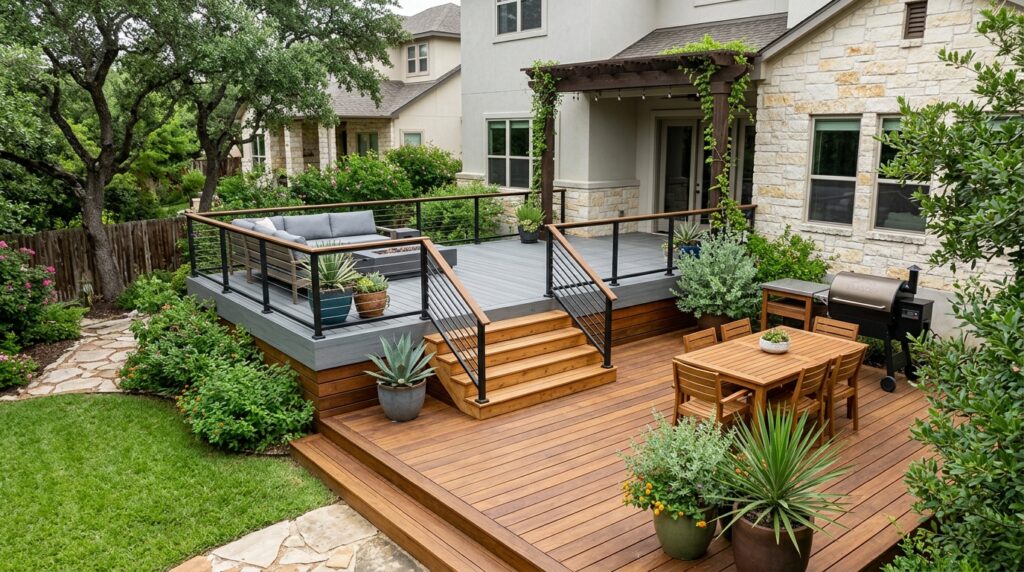
Some San Antonio homes, including newer two-story builds and older homes with walkout second floors, have a door that opens onto nothing but air. That wasted opening is one of the best starting points for a raised platform. A deck off a second-story door frames the view, creates outdoor living space where there was none, and connects the house to the yard in a way that stair-only access never does.
The structural demands of an elevated deck are different from ground-level work. Post sizing, beam spans, and the ledger connection to the house all carry more consequence when the platform is eight or ten feet off the ground. We engineer these builds to meet San Antonio’s permit requirements and then some, because a deck this high has to perform for decades without any give. A well-built upper deck off a second-story door can anchor a full staircase to the yard below, effectively creating a two-level system even if the lower connection is just a landing and a path.
Texas sun is the great equalizer. It doesn’t matter how nice your deck is if nobody can stand on it between 11 a.m. and 4 p.m. from April through September. A pergola on the upper level of a multi-level deck solves the comfort problem without walling off the view. The open-beam structure cuts direct UV while still letting air move through, which matters in San Antonio’s high-humidity summer heat.
Our pergola installations often pair with the upper tier because that’s where most families spend their time: close to the door, close to the kitchen, close to the cooler. Putting the shade structure where it matters most means the lower levels can stay open for lawn access and activities. A cedar or powder-coated aluminum pergola overhead also gives you a natural attachment point for fans, string lights, and retractable shade panels.
Anyone who has tried to enjoy a Texas evening in late spring knows what a difference a screen makes. Mosquitoes in San Antonio are aggressive, and the humidity holds heat long after the sun drops. Adding a screened tier to your outdoor structure turns at least one zone into a genuinely usable room from dusk until midnight, not just the hours before noon.
A screened porch level works best positioned close to the house, usually at the same elevation as the interior floor, with a solid roof overhead. Check out how we approach these at our screened porches service page. The open tiers below can still catch a breeze and handle foot traffic from the yard, while the screened level stays bug-free for dining, conversation, or working remotely. Building the screen room as one tier of a larger multi-level system lets you get the protection you need without giving up the connected, layered feel of the full design.
One of the underused design moves on a multi-level deck is letting each tier tell a slightly different material story. The upper level, the one closest to the house and subject to the most foot traffic, is a good candidate for composite decking. Boards from brands like Trex and TimberTech resist the fading and cracking that unprotected wood accumulates fast under San Antonio’s UV load, and they hold up against cooking-zone traffic without splintering.
The lower levels, especially any tier that connects to a lawn area or transitions to concrete, can shift to pressure-treated wood or natural hardwood for a different look and feel. Mixing materials between tiers is also a practical way to match existing exterior elements. If the house has cedar trim, a cedar-railed lower level ties into the architecture in a way that board products alone couldn’t. The key is keeping a consistent color palette so the levels read as one cohesive design even when the board products differ. Running one tier parallel to the house and the next perpendicular is a low-cost way to visually define different areas without a material change.
On a single-level deck, stairs are an afterthought, usually tucked in a corner and sized to code minimum. On a multi-level deck, stairs are part of the architecture. They are the connective tissue between platforms and one of the first things a visitor notices. Wide, sweeping stairs with a gentle rise feel generous and welcoming. Tight, steep stairs feel like an emergency exit.
Landings matter just as much. A landing between a long stair run breaks the climb, creates a place to pause, and gives the builder a chance to add a planter, a low wall, or a lighting element. Railing design on a multi-level build gets especially interesting because different levels can carry different styles — cable railing on the upper tier for an open view, wood post-and-rail on the lower tier for a warmer feel. Lighting integrated into the railing posts or stair stringers turns the whole structure into something that looks intentional and finished at night, not just functional during the day.
Drop the lowest tier eight to twelve inches below grade, or frame it at a lower elevation than the surrounding lawn, and you have a sunken lounge that feels like a private outdoor room. This design works especially well at the far end of a multi-level build where the yard has already dropped away and you want a terminal destination, not just an exit point. A sunken level with a built-in fire-pit ring and wraparound seating becomes the natural gathering spot after dark.
San Antonio evenings in fall and winter are genuinely pleasant, and a fire-pit level extends the season considerably. The sunken geometry also helps block wind, which picks up on open Hill Country lots. Patio-style concrete pavers at the base of the sunken zone keep the material cost manageable while giving you a non-combustible surface around the fire feature. Pair it with a pergola or overhead structure and you have a true outdoor living room that functions on its own when you want it to.
Tiered outdoor structures are a meaningful structural investment, and the safety considerations are more involved than a single ground-level platform. Two questions come up regularly when homeowners research deck safety, and they’re worth addressing directly before you start planning your build.
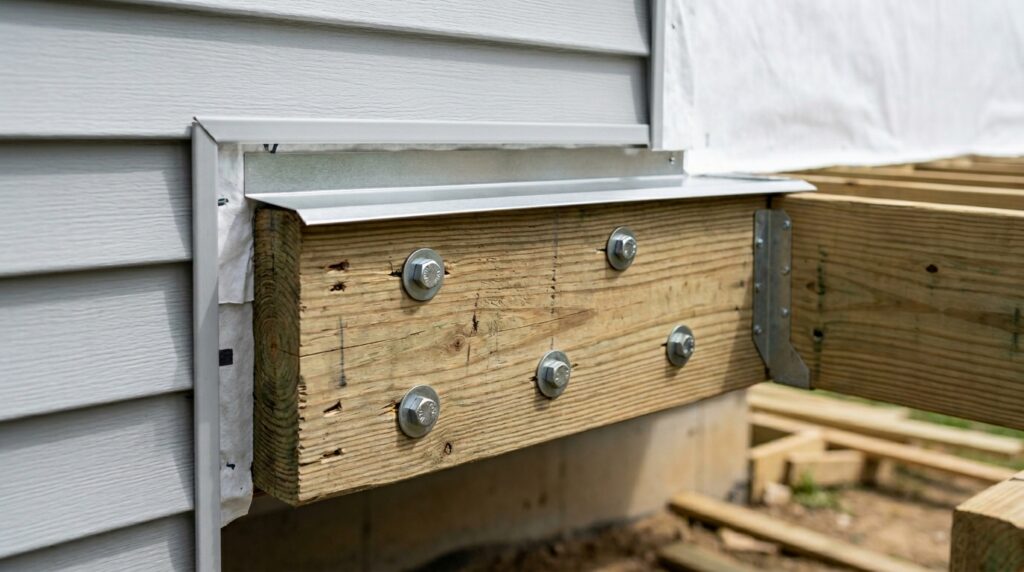
Ledger failure, meaning the connection between the deck’s frame and the house’s rim joist, is the leading cause of deck collapses. A poorly attached ledger can pull away from the house under load, taking the entire structure with it. Proper ledger installation means through-bolting into structural framing (not just sheathing or siding), using the correct lag diameter and spacing per the span tables, and flashing the connection to prevent moisture intrusion that rots the rim joist over time. If you’re concerned about an existing structure, our deck repair team can inspect and reinforce ledger connections before they become a problem.
The 3/4/5 rule is a field method for confirming that a corner is truly square. Measure three feet along one side of a corner, four feet along the other side, and check that the diagonal between those two points is exactly five feet. If it is, the corner is square. This applies to every level of a multi-level build independently. A corner that’s off by even half an inch at the upper level can compound into a visible lean or a railing that doesn’t sit flush by the time you’re at the lower tier. Following deck safety standards set by organizations like the North American Deck and Railing Association ensures that framing, connections, and load paths all meet the minimums that protect your family for the life of the structure.
Our San Antonio deck builders have worked on sloped Hill Country lots, flat suburban yards, and everything in between, and a multi-level deck almost always outperforms a single platform when the grade and the family’s lifestyle call for it. Whether you’re starting with a clear picture or just a slope and a door that needs somewhere to go, we can walk your yard and give you a real plan. Get a Free Estimate by calling (210) 387-1286 today.
Copyright © 2026 Prestige Deck Builder. All rights reserved.