You step outside in July, barefoot, ready to enjoy the backyard. The second your foot hits the boards, you’re hopping back inside. If you’ve owned a dark wood deck in San Antonio, you already know how brutal the afternoon sun can be. The real question is whether a composite deck holds up any better underfoot, or whether you’re just trading one problem for another.
Honest answer: the material does warm up in direct sun. So does concrete, tile, and every other outdoor surface. What matters is how much, and what you can do about it. That’s what this guide covers.
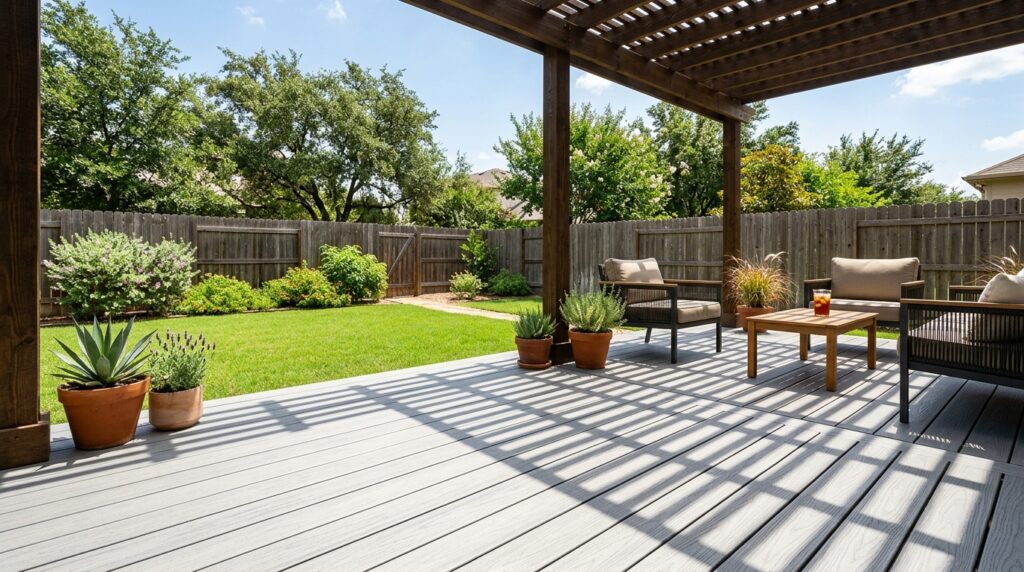
Yes, composite decking does get hot in direct sun, just like lumber, concrete, and pavers. The key factor is board color: lighter tones stay significantly cooler than darker ones, sometimes by 20°F or more on a Texas afternoon. Whether it becomes a real problem depends mostly on your shade situation and the tone you pick.
San Antonio summers are not forgiving. We’re talking triple-digit readings for weeks at a time, intense UV from a near-cloudless sky, and direct sun hammering a south- or west-facing deck from midday straight through evening. Every outdoor material gets warm under those conditions. The question isn’t whether it warms up, it’s how much, and how quickly it cools back down once the sun moves off.
The good news: this is a manageable issue, not a dealbreaker. Thousands of San Antonio homeowners enjoy their decks all summer without a second thought. It just takes the right choices up front.
All solid surfaces absorb solar radiation and convert it to heat. The boards on your deck are no exception. They soak up energy from direct sunlight and hold it, which is why a full-sun deck can feel much warmer than the outdoor air temperature reading suggests.
A few things drive how warm a deck gets:
Board orientation also plays a role most people don’t think about. Boards laid parallel to the prevailing breeze allow more airflow across the surface, which helps dissipate heat faster than boards laid perpendicular. It’s a small detail, but on a full-sun deck in August, every degree matters.
Modern decking boards include a capped outer layer that helps resist fading and staining, but that cap doesn’t dramatically reduce heat absorption on its own. The tone you choose matters far more than any single technology in the board itself.
If there’s one thing we want every San Antonio homeowner to understand before selecting boards, it’s this: the tone you pick is the single biggest variable controlling how warm things get underfoot. More than brand. More than what the boards are made of. More than anything else you choose at the selection stage.
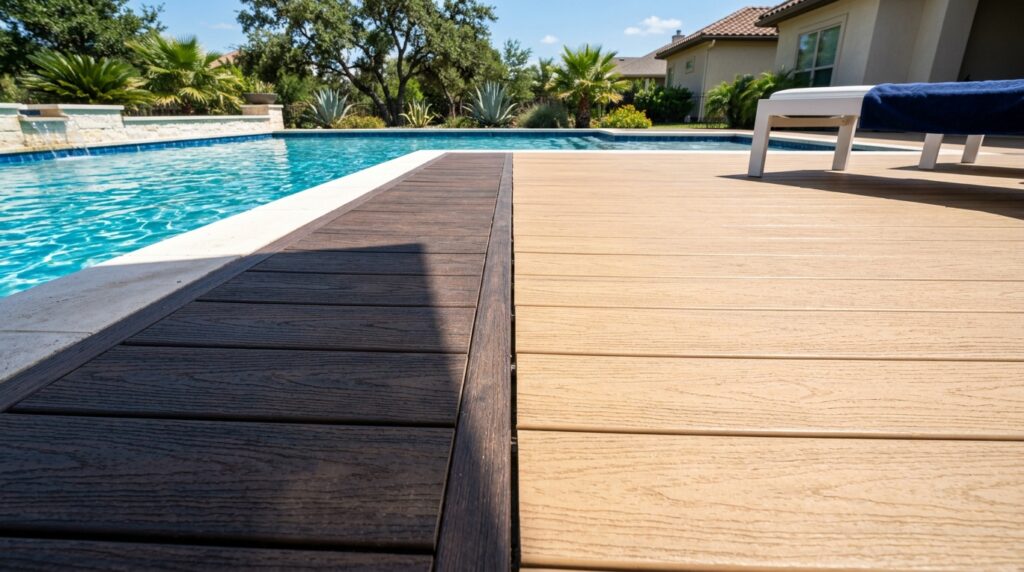
Light grays, sandy tans, driftwood tones, and pale natural looks reflect more solar energy than they absorb. On a July afternoon, a light-toned board can run noticeably cooler than a darker one baking in the same sun. We steer most of our full-sun San Antonio clients toward lighter boards for exactly this reason, especially on pool decks and open patios where bare feet and pets are constant. Surface temperatures climb fast in July, and choosing the right color up front is your best line of defense.
Brands like Trex and TimberTech both offer light-toned collections with heat-resistant composite decking performance in mind. If staying cooler underfoot is a priority, their lighter lines are worth a close look.
Deep browns, charcoal grays, espresso, and near-black tones are popular for the rich, dramatic look they create. But those deep pigments pull in solar energy aggressively. On a full-sun deck in August, deeply-toned boards can get genuinely uncomfortable for bare feet. Kids notice it fast. So do pets.
That doesn’t mean a deeper shade is off the table. It means those tones work best when the deck gets meaningful shade during peak hours, or when you’re already planning to add a pergola or shade structure overhead.
Most homeowners expect composite materials to run hotter than traditional lumber. In practice the comparison is much closer, and the boards often come out ahead when you match similar shades.
How warm any deck runs depends heavily on species and stain. Light-stained cedar stays relatively comfortable underfoot. A dark-stained hardwood in the same conditions gets just as warm as a deeply-toned composite board. The physics are the same: darker pigments absorb more energy, lighter ones reflect it.
Light-toned boards run roughly comparable to similarly-stained lumber, and in some cases stay slightly cooler once the sun moves off. The capped outer layer releases residual warmth a bit faster than raw lumber fiber. Where composite decking has a clear edge is longevity: natural boards splinter, weather rough, and tend to age poorly through San Antonio’s brutal summers. The boards you choose today keep their finish far longer without the annual maintenance cycle.
This issue is real, and it’s also very solvable. Here are the moves that make the biggest difference.
A pergola changes everything. Even a partially open structure dramatically cuts direct sun during peak hours, and a covered pergola or shade sail can drop the surface temperature on boards below it by 30°F or more. If you’re building in a south- or west-facing yard, adding a pergola as part of the project isn’t a luxury, it’s the primary heat mitigation strategy. Natural tree coverage positioned to shade the space during afternoon hours does the same job and costs nothing once established.
We’ve covered this, but it stands on its own as an action item: if warmth underfoot is your concern, pick the lightest tone you can live with aesthetically. You have more flexibility on a north-facing deck or a heavily shaded space. But for open south-facing yards and pool deck areas where bare feet are constant, stick to lighter boards. Don’t let the showroom mislead you. That rich charcoal sample looks great under fluorescent lights. Picture it at 3 PM in August.
A few simple habits make a real difference once the deck is built:
Proper deck maintenance also plays a role. Keeping boards clean and free of dirt buildup, which traps extra warmth, helps them perform as designed through years of San Antonio weather.
Questions about the summer sun come up in almost every conversation we have about outdoor builds, and they should. San Antonio gets serious sun, and the concern is completely fair. But when you look at the full picture, it holds up well for Texas conditions.
No splinters, ever. No annual sealing or staining. Strong resistance to the fade and stain that beats up natural boards after a few brutal summers. Consistent structure that doesn’t warp or crack through Texas freeze-thaw cycles. These are real advantages for any homeowner who wants a backyard they can actually use without a maintenance schedule attached.
The answer to the heat question is straightforward: pick lighter tones, plan for shade, and you’ll have a composite deck that’s comfortable all summer. That combination — the right board shade plus a covered pergola or shade structure — is how most San Antonio homeowners land on an outdoor space that works year-round. Our San Antonio deck builders are happy to walk you through exactly what makes sense for your yard and your situation.
Get a Free Estimate or call us at (210) 387-1286.
No outdoor material stays truly cool in 100°F direct sun. But lighter-toned boards with good overhead shade come as close as anything available. If staying comfortable underfoot is the priority, that combination delivers the best real-world result in a Texas backyard.
Shade is the most effective tool. After that: lighter board tones, a quick rinse before you plan to use the space, and rugs over high-foot-traffic zones. Orienting the deck to take advantage of natural tree coverage or the house shadow also knocks down warmth buildup significantly during the worst afternoon hours.
It depends on what you’re comparing. A deeply-toned board versus light cedar: the cedar wins. A light-toned board versus a dark-stained hardwood: the lighter board wins. Match similar shades and the performance is roughly equivalent. Where composite decking has a lasting edge is durability. Natural boards get rougher and tend to age poorly, while the recycled plastic and wood fiber construction holds its original look far longer under San Antonio’s tough conditions.
Copyright © 2026 Prestige Deck Builder. All rights reserved.