If you’re planning an outdoor living project in San Antonio, you’ve probably hit the same fork in the road most homeowners reach first: raised structure or ground-level surface? Both add usable outdoor space. Both add value. But they’re built differently, perform differently, and on a typical San Antonio lot with sloped terrain, heavy clay soil, and brutal summer heat, one option usually fits your situation better. This guide breaks down the deck vs patio decision the way a builder would, with honest trade-offs and the local context that actually matters here.
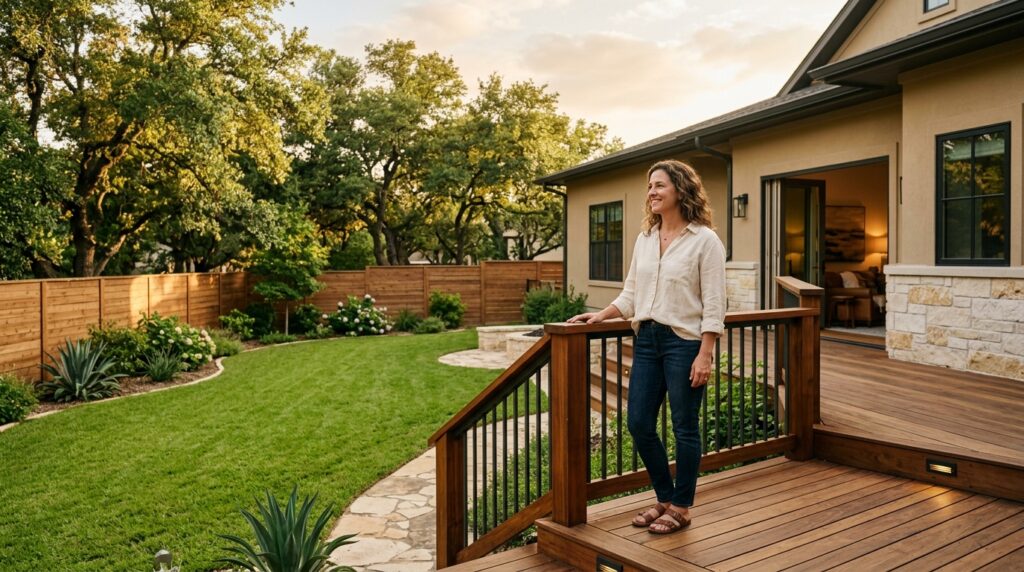
A deck will add value to your home in two distinct ways: appraised equity and buyer enthusiasm. Both show up when you list, and they tend to reinforce each other.
On straight ROI, a wood deck typically recoups 60–70% of project cost at sale. That outperforms most interior remodels.
The average home sales price in competitive San Antonio neighborhoods reflects this. Properties with quality outdoor living areas routinely close nearer to asking price compared to similar listings without them.
Beyond the numbers, a finished build shortens time on the listing. Buyers walk out the back door during showings and immediately start picturing summer evenings. That emotional response matters at offer time more than sellers often expect.
Property value may increase from the structure itself and from what it signals about the home’s upkeep. Buyers read a well-maintained outdoor build as evidence the whole property has been cared for, and that perception carries through the entire showing.
Pressure-treated lumber and redwood decks show the highest ROI percentages in Cost vs. Value data. A right-sized addition almost always outperforms an oversized build. Proportion and fit matter to appraisers, and buyers respond to a structure that feels like it belongs to the property.
Buyers also price in what they’d spend to build a deck themselves. When one is already there — built well and maintained — they often offer more just to skip a future project. Value can vary significantly based on condition and design, but the direction is consistent: a quality build commands a premium over a bare or neglected yard.
The value a deck adds is not fixed. Several variables push the number up or down. Here are the four that matter most.
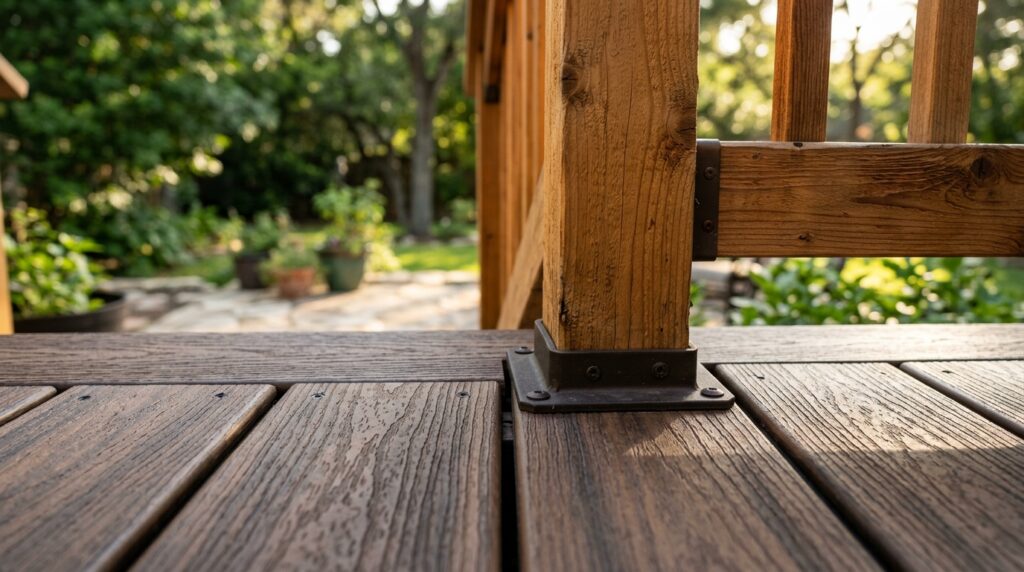
Deck material is one of the first things appraisers document and buyers notice. Pressure-treated wood is the benchmark — broad appeal, strong return percentage, proven performance.
Cedar holds up well in humid climates. Composite signals low upkeep, which draws buyers who want a property ready to enjoy without inheriting a maintenance list on move-in day.
Choosing deck materials that match your neighborhood’s price point matters. Over-improving with premium decking in a modest area caps your return because the local price ceiling limits what buyers will pay.
An addition should feel like a natural extension of the property. The sweet spot is typically 10–15% of the home’s total square footage.
A well-proportioned build reads as intentional. An oversized one reads as excess. Appraisers apply diminishing returns to over-scaled projects, and buyers are often put off by a backyard that’s mostly planks with nowhere to use the grass.
A sagging structure, loose posts, or boards with visible rot will hurt your listing more than having no deck at all. Buyers and inspectors catch these issues fast.
The concern spreads too — once a buyer flags one problem outside, they look harder at everything else inside. If your current build is rough, professional deck repair and restoration before listing often recovers more than the cost of the work.
Quality also shows in the details. Level boards, tight framing, finished stairs — buyers who know what they’re looking at identify a well-built structure from the first step, and that confidence carries into their offer.
An outdoor build that matches the home’s style and lot adds real value. One that looks like an afterthought doesn’t.
Coordinating the design with your siding, sizing the structure to the door and yard, and adding built-in seating or lighting signal that care went into the project. That design coherence separates a build that lifts the sale price from one that gets a shrug.
Both materials add value at listing. The difference shows up in timing, buyer preference, and how the math changes across a longer ownership horizon. Knowing which profile your target buyer fits helps you choose the right one.
Treated lumber decks are still the benchmark in Cost vs. Value data. They have broad buyer acceptance, strong return percentages, and look excellent when properly maintained.
The catch is upkeep. Regular sealing, staining, and inspection are necessary. A neglected structure loses value quickly under Texas heat and humidity cycles. A maintained one with fresh finish is a genuine selling point buyers can see and respond to.
Composite carries a higher upfront cost, which can compress the percentage recovered at listing. But this material eliminates the maintenance cycle that causes treated lumber to deteriorate over time.
Buyers who want a move-in-ready property often prefer it. For pool decks and outdoor living upgrades, composite tends to hold its structure and finish under Texas conditions that age natural lumber faster.
The bottom line: planning to sell within a few years, pressure-treated lumber with solid upkeep typically delivers the best resale percentage. Planning to keep the home for a decade first, composite’s lower lifetime costs change the equation. Either way, condition at listing time matters more than material alone.
Cost vs. Value data is built on averages across all climates and seasons. San Antonio is not average on outdoor living expectations, and that raises the value equation in your favor.
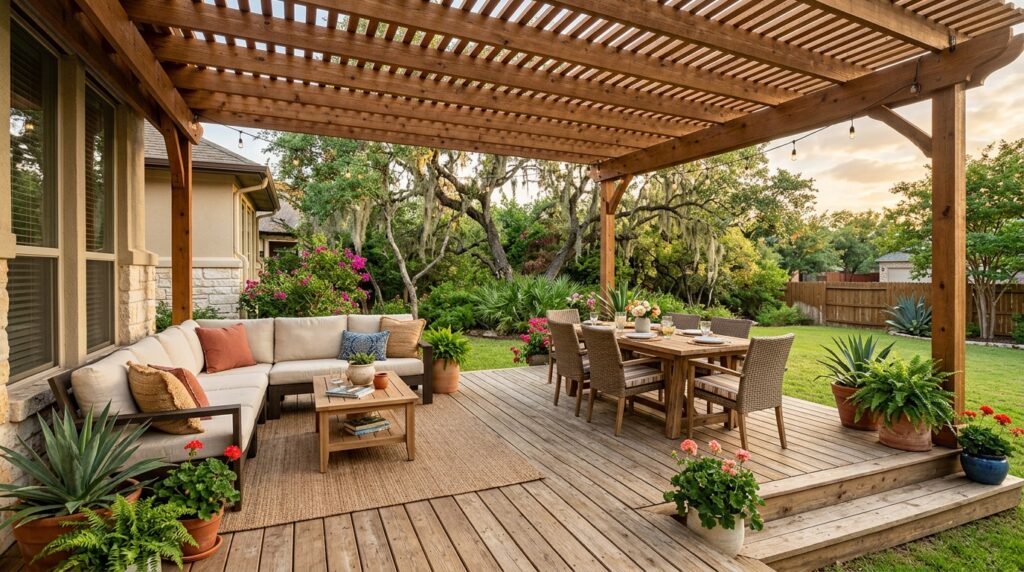
San Antonio averages over 220 sunny days per year. Buyers here don’t hope for a livable outdoor space — they expect one as part of the package.
A quality build with shade coverage extends usable square footage for ten or eleven months a year. Buyers factor that directly into their offers, and listings with finished decks consistently attract stronger numbers than those without.
Buyers relocating from cooler climates arrive with an outdoor living mindset already formed. A well-built deck on your property puts you ahead of comparable listings from the first showing.
San Antonio summers are demanding. Triple-digit temperatures and moisture cycles put real stress on decking materials and framing.
A structure built without accounting for heat expansion, UV exposure, and humidity will deteriorate faster — and that shows up visibly at listing time.
The San Antonio deck builders who know this climate select materials rated for Texas conditions. That choice shows in how the structure ages and how buyers respond when they walk out to inspect it.
In competitive San Antonio neighborhoods — Stone Oak, Alamo Heights, Helotes, Schertz — backyard upgrades are expected at certain price points.
A well-built deck signals quality investment and raises buyer expectations across the whole property. Skipping the addition in those neighborhoods doesn’t save money. Comparable listings with finished backyard areas attract stronger offers and fewer days on market than those without.
Yes, when it’s executed properly. You get two kinds of return: financial value at listing and quality of life during the years you live there. The lifestyle return just doesn’t show up on a spreadsheet.
The investment performs best when your neighborhood supports it. Adding a deck where comparables already have one brings you to local standard. Building in an appreciating area where buyers increasingly expect outdoor space puts you ahead.
A deck addition built two to three years before listing tends to show better than one rushed in before a sale. It has time to get maintained and demonstrate quality — both of which matter to buyers and appraisers.
A deck is not automatically a plus. Built poorly, neglected, or added without proper permits, it becomes a liability at listing time rather than an asset.
Rotting boards, cracked footings, a loose post, or mold staining tell buyers the property has been neglected.
That read doesn’t stay outside — it follows them through the entire showing. Deferred maintenance on a visible feature makes buyers suspicious about what else has been ignored.
Professional deck repair and restoration before listing typically recovers far more than the cost of the work. Don’t let an aging structure cancel out the value it could be adding to your sale.
An unpermitted deck creates legal exposure for buyers. A real estate agent’s disclosure requirements and title searches often surface unpermitted structures.
Buyers use them as leverage or a reason to walk. If your deck was built without permits, resolve that before listing. The cost to correct it almost always beats the price reductions buyers will demand when they find it during due diligence.
A build that dominates the yard or looks architecturally mismatched hurts the listing. Installing premium materials in a neighborhood where the price ceiling doesn’t support the investment compresses your return. Know your area’s range before you build.
Treated lumber deck additions consistently recoup 60–70% or more of project cost at sale. In a strong outdoor-living city like San Antonio, results often perform at the higher end of that range.
Beyond direct cost recovery, a quality build reduces days on market and raises buyer interest — both of which move the final number in your favor.
Yes, in most cases. It’s a good investment when it fits your home’s scale, matches your neighborhood’s price range, and gets properly maintained.
You get returns during ownership through improved livability, and again at listing when buyers factor outdoor living into their offers. The return is strongest when the build is permitted, well-maintained, and designed to show well.
In San Antonio’s market, raised decks generally outperform ground-level patios in buyer response. Decks lift the outdoor space visually, accommodate shade structures more easily, and signal a higher level of investment in the property.
Some properties benefit from both — a deck off the main living area combined with a lower-level patio near the pool. But a quality deck reliably generates stronger buyer response here than a plain slab alone.
Yes, significantly. Buyers treat unpermitted structures as negotiating leverage or dealbreakers. Agents are required to disclose known issues, and title searches regularly surface them anyway. Address it before listing — the cost to resolve it almost always beats the concessions buyers will extract once they find it.
A well-built, permitted, and properly maintained deck reliably adds value — both at listing and during the years you live there. San Antonio’s climate and open-air living expectations make this upgrade especially worthwhile in this area.
A new deck will add value when it’s sized right and built right. It will increase your home value at listing while improving daily life in the years before you sell. Buyers expect it. The numbers support it.
Get a Free Estimate from Prestige Deck Builders of San Antonio or call (210) 387-1286. We build decks designed for the Texas climate, built to protect your investment.
Copyright © 2026 Prestige Deck Builder. All rights reserved.