Picture it: a cool January evening in San Antonio, steam rising off a hot tub, you and your family relaxing under the stars. Then the question hits you. Will my deck actually hold this thing? It’s the right question to ask before you buy a spa, and the answer is yes. A properly engineered or reinforced structure can safely support a hot tub. But a standard residential deck cannot handle that load without upgrades, and skipping that step is how things fail.
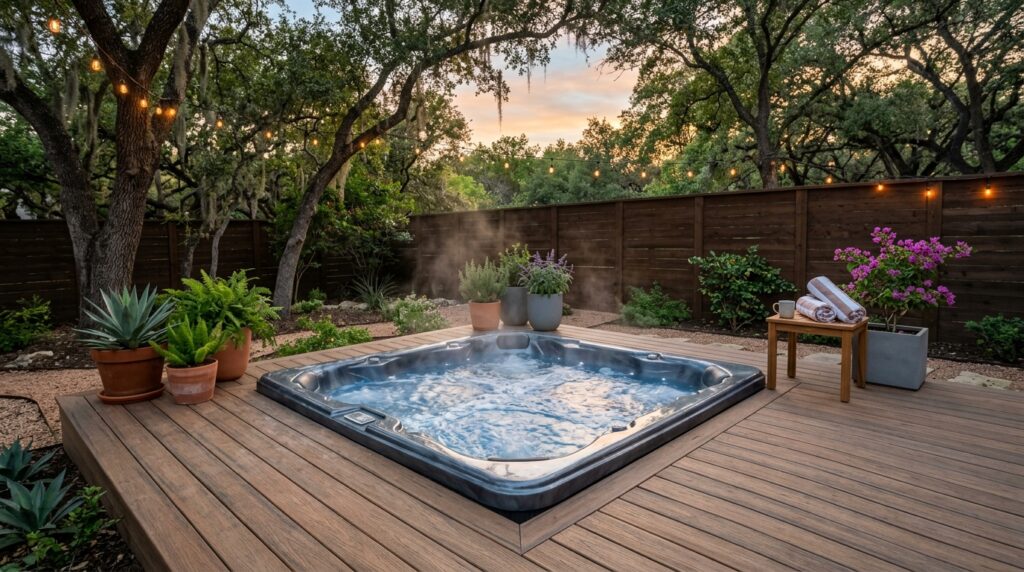
A properly engineered or reinforced deck can hold a hot tub, but a standard residential deck cannot without reinforcement. The framing, footings, and posts all need to be sized for the actual load, which is far heavier than most homeowners expect. Get the structure right from the start, and you’ll enjoy years of trouble-free soaking. Skip it, and you’re looking at serious damage or a dangerous failure.
Thousands of San Antonio homeowners have hot tubs on their decks, and they work beautifully when the structure is designed for it. The key is knowing what “designed for it” actually means, which is exactly what we’ll walk through here.
Most homeowners don’t see the weight coming. A hot tub feels like furniture until you factor in the water. Water weighs approximately 8.3 pounds per gallon, and a mid-size six- to seven-person spa holds somewhere between 400 and 500 gallons. Fill it up, add four or five adults, and you’re looking at roughly 5,000 pounds concentrated in a relatively small footprint.
That deck weight doesn’t spread evenly across the surface the way people walking around do. It sits in one spot, permanently, pressing down on whatever framing is directly below it. The difference between guests at a backyard party and a loaded hot tub is enormous from a structural standpoint. Standard residential decks are typically designed for 40 to 50 pounds per square foot of live load, and a filled unit can exceed 100 pounds per square foot depending on its size.
A structure that handles a summer barbecue without complaint can fail catastrophically under that kind of sustained, concentrated load if it isn’t sized to specification. Getting clear on the numbers is the first step toward creating something that lasts.
Evaluating whether your existing structure can support a hot tub takes more than a quick visual check from above. A qualified evaluation looks at the whole system, from the footings in the ground up through the posts, beams, joists, and decking surface. A weakness anywhere in that chain is a problem.
A structural evaluation typically covers:
When a San Antonio homeowner asks us to add a hot tub to an existing deck, the first thing we do is get under it and check the framing. We look at joist size, spacing, and condition; the beam and how it’s supported; the posts and post bases; and the footings. Most of the time, we find at least one component that needs attention before we’d feel comfortable placing a hot tub on that structure.
If your existing deck needs structural upgrades, the good news is that it’s very doable. Strengthening the framing is a genuine upgrade, not a patch or workaround. Done right, it makes the structure more capable than it was before. The work is easiest during new construction, but it can absolutely be added to an existing system.
Common approaches include:
This kind of structural work is a normal part of any hot tub deck project. The goal is a deck foundation capable of carrying the load safely for the life of the structure, not just today, but twenty years from now. If a contractor tells you your existing deck is fine without getting under it to check, that’s a red flag worth taking seriously.
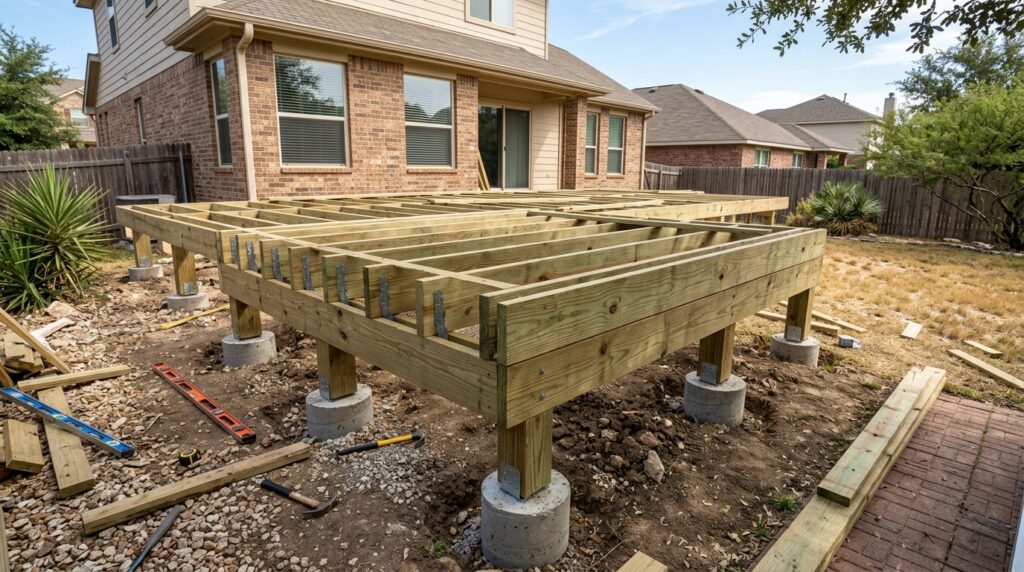
Where you put a hot tub, at grade or elevated, makes a significant difference in both the engineering and the complexity of the project. A ground-level or low-profile structure is far simpler to design for heavy loads. The load path to the ground is short, footings can be accessed and poured easily, and there’s less leverage stress on the components.
A raised or second-story deck is a different situation. The taller the structure, the more lateral forces and moments come into play. An elevated platform holding a 5,000-pound hot tub also needs to account for guard rail loads and the dynamic forces of people getting in and out. That requires a more thorough engineering review, and in some cases a stamped engineer’s plan may be required to pull a permit.
That doesn’t mean you can’t put a hot tub on a raised deck. It means the structural design has to be done carefully and to code. If you’re starting fresh with a hot tub in mind, work with a contractor who understands the load requirements from day one. Retrofitting an elevated structure after the fact is more complicated than designing it right from the start.
For most San Antonio homeowners with a ground-level setup, the path forward is fairly clear. For significantly raised structures, budget time for engineering review and permit coordination. Knowing your structure is properly engineered is something you’ll appreciate every time you climb in.
This is the scenario most homeowners are actually dealing with. They already have a deck and want to add a hot tub. The honest answer: maybe, but only after a real evaluation. Don’t assume the existing structure can handle it just because it feels solid underfoot. The loads involved are far higher than anything it has carried before.
To properly reinforce existing deck framing, a qualified contractor will need access to the underside. If your setup is on-grade with limited clearance, that may mean removing a few planks for access, a minor inconvenience compared to the cost of a structural failure. If the structure is raised, getting underneath is usually easy.
What you’re hoping to find is framing in good condition (no rot, no insect damage, no significant deflection or bounce) along with joists and beams that can be supplemented or sistered to handle the added load. What you don’t want to find is deteriorated lumber or footings that weren’t properly installed to begin with. If problems exist, it’s far better to address them now than after a 5,000-pound hot tub is sitting on top.
The age of the structure matters too. Decks built more than fifteen or twenty years ago may have been constructed to older standards, and the lumber itself may have lost some structural integrity over time. An older deck isn’t automatically a no, but it needs a thorough look before you put a hot tub on it.
The surface material under and around your hot tub matters more than people realize. Hot tubs mean constant moisture exposure: steam, splash-out, condensation, and wet feet moving between the tub and the rest of the area. The wrong material will deteriorate quickly and become a slip hazard.
Composite decking is often the ideal choice for hot tub areas. It doesn’t absorb moisture the way natural wood does, it resists mold and mildew growth, and it holds up to the UV exposure that’s a constant factor in San Antonio. High-quality composite slats won’t splinter or crack under the combination of moisture and heat, and they’re available in non-slip textured finishes, which matters around any water feature. Our team discusses these options with most homeowners planning a spa installation for exactly these reasons.
Wood decking can work well, but it requires more upkeep in a wet environment. Pressure-treated lumber is the baseline, but it needs to be properly sealed and maintained to resist moisture damage. Hardwoods like ipe and cumaru are naturally resistant to moisture and insects, but they’re at the premium end and still require periodic oiling. For protecting your surface under a wet spa environment, staying current with sealing and cleaning is critical with any wood product.
Whatever material you choose, make sure the surface has adequate spacing for drainage. Water pooling beneath the hot tub promotes rot in wood structures and can contribute to mold in the framing it contacts. Good drainage design is part of any well-planned spa deck.
Deciding where to place a hot tub on your deck involves more than aesthetics and views. There are practical constraints that need to be worked through during planning, and they’re much easier to handle before construction than after.
Electrical is the big one. A hot tub requires a dedicated 240-volt circuit, typically 50 to 60 amps, run from your main panel. The circuit must be installed by a licensed electrician, and the disconnect box must be placed within sight of the hot tub but at least five feet away, a code requirement for safety. Before finalizing your hot tub’s position, walk the electrical path from your panel. A long run through difficult territory adds complexity.
Drainage and splash-out are worth thinking through carefully. Hot tubs splash. Steam creates condensation. The area around the tub gets wet regularly, and that water needs somewhere to go that isn’t pooling against the house foundation or saturating the framing. Good grade and drainage design at the planning stage prevents headaches later.
Other placement considerations:
Thinking through all of these factors before construction starts is the difference between a spa that works seamlessly and one that creates ongoing problems. Our San Antonio deck builders walk through these decisions with every homeowner, because it’s too important to leave to chance.
In San Antonio, you can use a hot tub year-round. Winters here are mild enough that soaking outdoors in January is genuinely comfortable. A warm evening and a steaming spa is one of the better things about living in South Texas, and it’s available for most of the calendar year in a way it simply isn’t in colder climates.
That year-round use means your deck takes more sustained exposure to moisture and temperature cycles than one used only in summer. San Antonio’s climate, with hot, humid summers followed by mild but occasionally wet winters, puts real demands on surface materials and finishes. UV exposure here is significant, and whether you go with composite or properly maintained wood, your material choice needs to account for that.
The clay soils throughout much of San Antonio add a structural consideration specific to this region. Expansive clay absorbs moisture and swells, then shrinks and contracts as it dries. Footings that don’t go deep enough will move with the soil, and shifting footings mean a shifting structure. Under a 5,000-pound spa, that’s a serious problem. Local contractors who know San Antonio soils will spec footings with that movement in mind. It’s one reason local experience matters when you’re creating a water-feature deck or outdoor leisure space.
Every evening you spend soaking outdoors without a second thought about the structure beneath you is the payoff for getting it right.
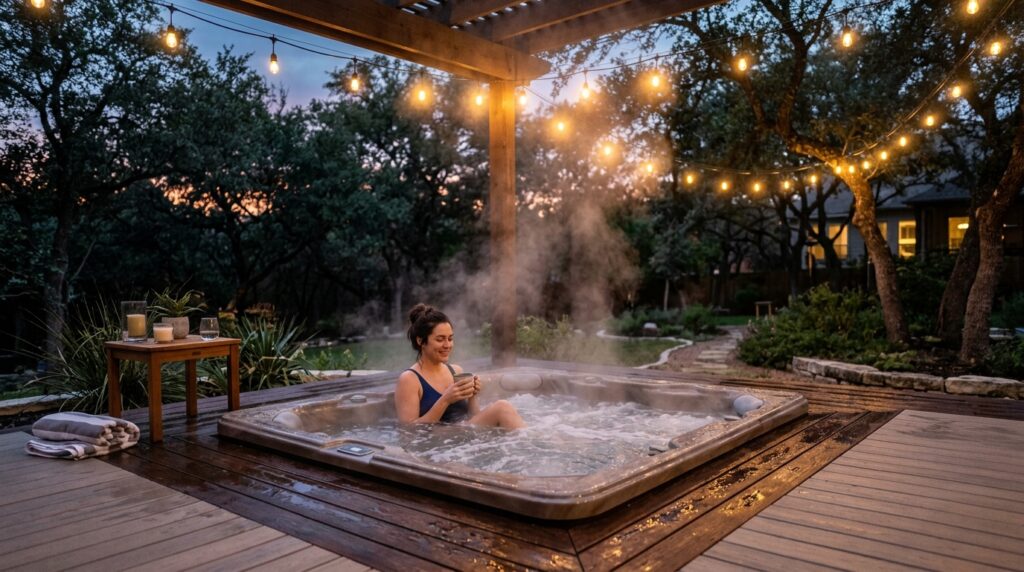
Yes. With the right structure, it’s an excellent setup. A dedicated spa area creates a private outdoor retreat that San Antonio homeowners can use consistently throughout the year. The key is ensuring everything is engineered for the load before installation. A properly designed hot tub deck is a long-lasting addition to your home that gets used regularly.
The alternative is placing the spa directly on a concrete pad at grade. That works, but it doesn’t give you the same integrated feel as a well-designed deck. Many homeowners prefer the deck option because it creates a more intentional outdoor living space. As long as the structural work is done correctly, it’s one of the better investments you can make in your backyard. Spas on well-designed decks tend to get used far more than those sitting awkwardly on a bare slab.
You consult a professional to inspect deck framing before you decide. A visual check from above isn’t enough. The framing underneath is where the real information lives. A qualified contractor or structural engineer will evaluate joist size and spacing, beam capacity, post sizing, footing depth and diameter, and the overall condition of the lumber. From there, they can tell you whether your existing structure is adequate, what upgrades are needed, or whether you’re starting from scratch.
Don’t rely on the age of the deck, how it looks from the surface, or how solid it feels underfoot. None of those are reliable indicators of whether it can handle a 5,000-pound concentrated load. Get someone under it who knows what they’re looking for.
Yes, but it requires more engineering attention than a ground-level structure. The taller the setup, the more complex the load path becomes, and the more important it is to have the design reviewed by someone who understands the structural requirements. In many cases, an elevated deck designed to hold a hot tub will require a permit with engineered drawings. That’s not a reason to avoid it. Plan for it and work with a contractor who has done it before. The result can be a spectacular elevated spa experience with views that make every evening worthwhile.
Getting a hot tub on a deck done right means starting with the structure: footings, framing, and materials sized for the actual load, not working backward from a purchase decision. When the engineering is right, the rest follows and you get years of use from a space that genuinely improves your outdoor life in San Antonio.
If you’re ready to create a new deck with a spa in mind, or you want an honest evaluation of what your existing structure needs, we’re here to help. Get a Free Estimate or call us at (210) 387-1286 — Prestige Deck Builders of San Antonio.
Copyright © 2026 Prestige Deck Builder. All rights reserved.